Planning your Italy Photography Adventure
This 12-day Italy itinerary takes you from Milan to Rome. Italy ranks among the world’s most photogenic destinations, offering a blend of ancient history, art, dramatic coastlines, and stunning countryside. This itinerary guides you 12 unforgettable days from Milan to Rome, specifically designed for photographers and families seeking to capture Italy’s most iconic landscapes while experiencing authentic Italian culture.
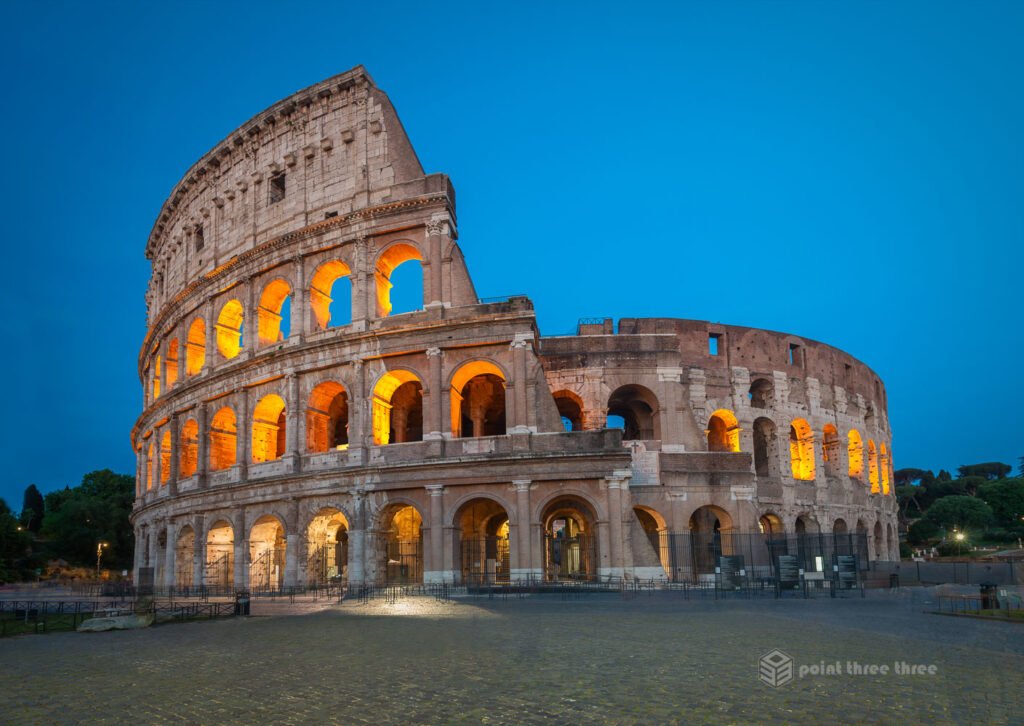
Our carefully planned route covers five distinct regions: cosmopolitan Milan, medieval Bologna, the coastal villages of Cinque Terre, Tuscany’s legendary Val d’Orcia countryside, and historic Rome. Each destination offers unique photographic opportunities, from sunrise at the Milan Duomo to sunset over Manarola’s colorful houses, the rolling cypress-lined hills of Tuscany, and golden hour at Rome’s ancient Colosseum.
Why This Italy Photography Itinerary Works
This 12-day route maximizes photographic diversity while maintaining manageable travel times between locations:
-
- Milan to Rome linear route
-
- No backtracking, efficient one-way car rental Strategic base locations
-
- La Spezia for Cinque Terre, Castiglione d’Orcia for Tuscany Balanced pace
-
- Mix of Surnrise/Sunset photography and family-friendly sightseeing Seasonal flexibility
-
- April-May (spring) or September-October (fall) for optimal light and fewer crowds Multiple photography genres
-
- Architecture, landscape, street, coastal, and sunset photography
Night-by-Night Breakdown:
-
- Nights 1-2: Milan (2 nights)
-
- Night 3: Bologna (1 night)
-
- Nights 4-5: La Spezia – base for Cinque Terre (2 nights)
-
- Nights 7-9: Tuscany – Val D’Orcia region (3 nights)
-
- Nights 10-12: Rome (4 nights)
Planning is absolutely key to maximize the number of locations you want to see on a trip like this.
This 12-day Italy photography journey exceeded expectations, delivering incredible diversity from cosmopolitan Milan to medieval Bologna, coastal Cinque Terre, Tuscany’s rolling hills, and Rome’s ancient grandeur. Each region offered completely different experiences, landscapes, and photographic opportunities.
This Route Works Well For:
-
- Photography enthusiasts willing to wake for sunrise
-
- Families with older children/young adults who can handle the pace
-
- Active travelers comfortable with extensive walking (15,000+ daily steps)
-
- People wanting diverse Italy experience in limited time (10-14 days available)
-
- Those comfortable driving in foreign countries
-
- Travelers interested in both cities and countryside
What We Missed: Pompeii Planning Mistake
Even with all the research we did, we still missed squeezing in Pompei, so we opted for an extra 4th night in Rome. The Original Plan was to visit Pompeii as day trip from Rome. We ended up cancelling that plan as direct trains which you really need was very expensive for a family of 4. Secondly, when we mapped out the amount of travel and overall timing it would have been an extremely long and exhausting day. We were just too ambitious in our original planning without looking enough into the details. As a result we spent an extra day in Rome and visited Capitoline museum which was great and we would have otherwise not toured it.
Car Rental and Driving in Italy:
If you can drive standard, you will save some extra dollars. This is a dying art in North American but works well for me.
Beware of the Rental Agency Upsell!
Rental companies aggressively sell toll payment plans. Avis almost tricked me into this. We declined and paid directly which saved us significant money even though we did a lot of driving. Just remember to take ticket entering autostrada (highway). I missed that once! You pay when exiting based on distance traveled and can pay with credit card at the toll booths. Just make sure to go to the correct booth which are typically marked well. But just in case, keep some cash available. We didn’t need it but I’m not sure if there are some that may require.
I have found the roads to be great to drive in Italy.
The roads can be narrow compared to North America and without “shoulders” to pull off on so you need to be mindful traveling in the country side of Tuscany.
Frankly the only issue I witnessed was the tourists that did not know how to drive in Italy! Other than that, if you have GPS Maps, don’t be afraid to rent and customize your trip!
Luggage Fit & Vehicle Security
Don’t just rent the cheapest car – research actual vehicle specifications:
✓ Check specific trunk dimensions online
✓ Family of 4 with luggage requires adequate space
✓ Verify trunk cover/concealment system
Security When Sightseeing: Your luggage will be in car while visiting attractions so make sure its fully covered/concealed for theft prevention. Hatchbacks with cover systems work well. This is another reason our family travels with Carry-on luggage ONLY. It not only saves us at the airports but also with selecting rental cars! Trade-off the extra pair of shoes and go with a carry-on bag!
One-Way Drop-Off Fees: Significant Cost Factor
This almost doubled our rental car fee! Shop around.
GPS Navigation
This might seem obvious, but having your smartphone GPS display on car’s screen is incredibly helpful for your Italy road trip. We had a Nissan Qashqai and while the car did have the software for Android Auto we could not get it to work.
At home you are familiar with your locations. Driving in foreign Italian cities with complex navigation is very different. I have found it much safer to have it linked than my phone propped up somewhere. One option is simply traveling with a holder, not a bad idea, but something else you need to pack.
Milan: Fashion Capital & Gothic Grandeur (2 Nights)
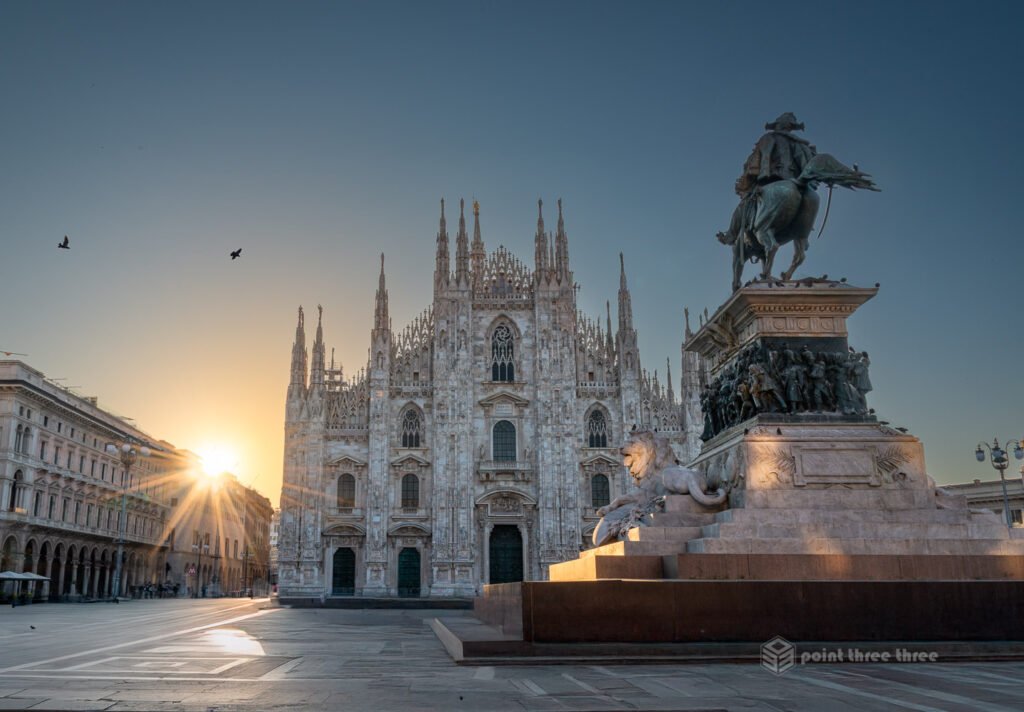
See also my photo: Duomo di Milano at Sunrise
Photography Highlights: Milan Duomo sunrise, Galleria Vittorio Emanuele II, Castello Sforzesco
Best Photo Times:** Sunrise at Piazza del Duomo (6:00-7:30 AM), evening at Galleria
Duomo di Milano
The Milan Cathedral (Duomo di Milano) represents the pinnacle of Gothic architecture in Italy and serves as the centerpiece for Milan photography. This massive white marble cathedral took nearly 600 years to complete (1386-1965) and features 3,400 statues, 135 spires, and 700 sculptural figures adorning its exterior.
To best photography the Duomo you will want to come before sunrise to minimize the crowds. The piazza can get very packed.
We highly recommend touring the Cathedral and purchasing your tickets online beforehand. Sadly, we booked our tickets a little too late and could not get a slot for the famous rooftop.
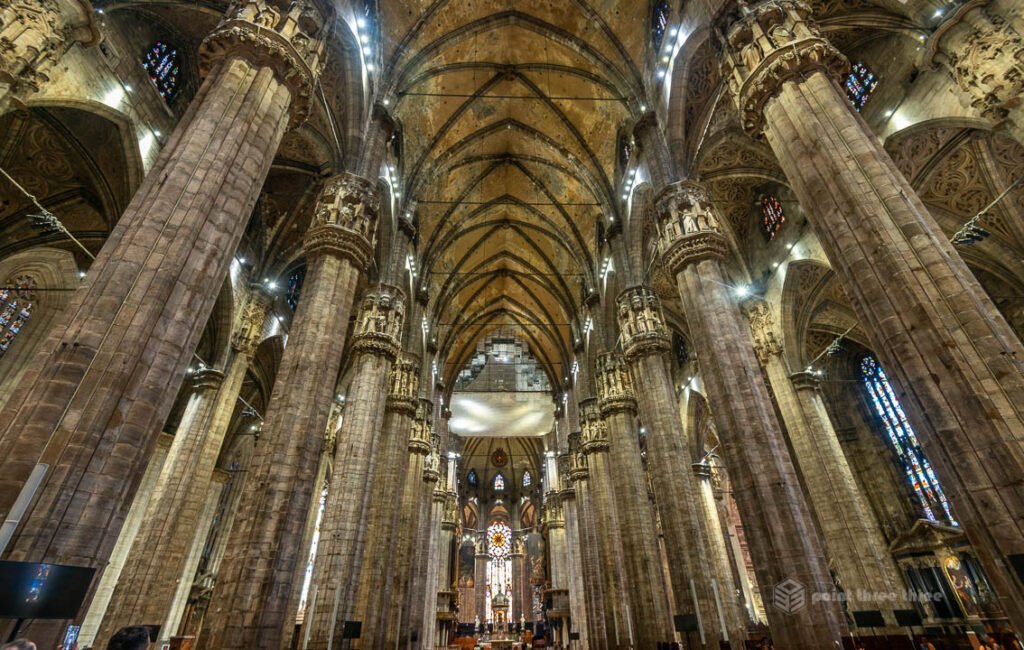
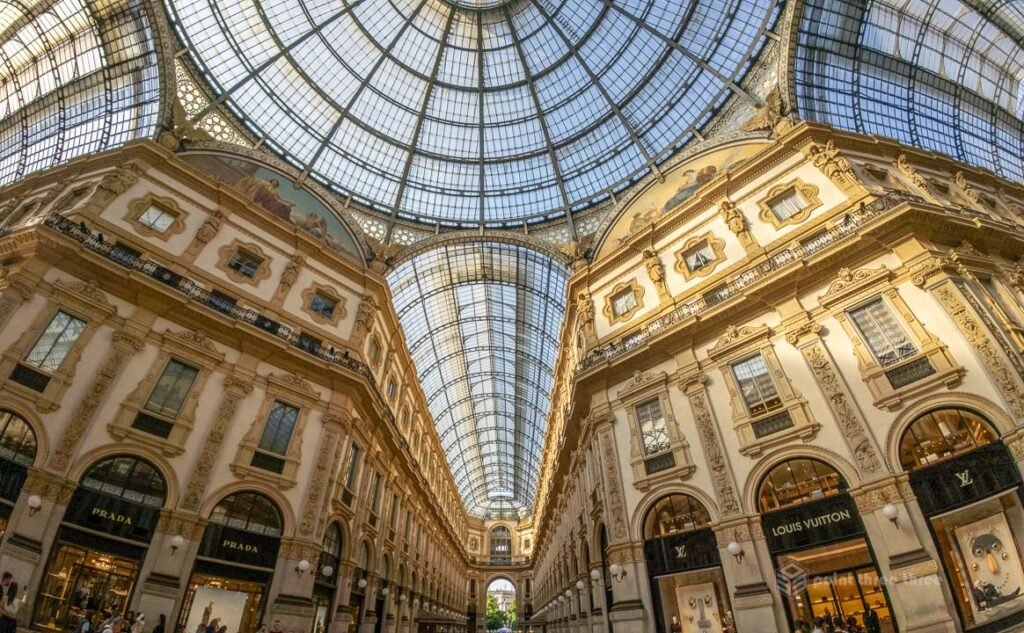
Other must-see sites in Milan include Galleria Vittorio Emanuele II; One of world’s oldest shopping arcades (1867), featuring spectacular iron-and-glass vaulted ceiling and octagonal dome.
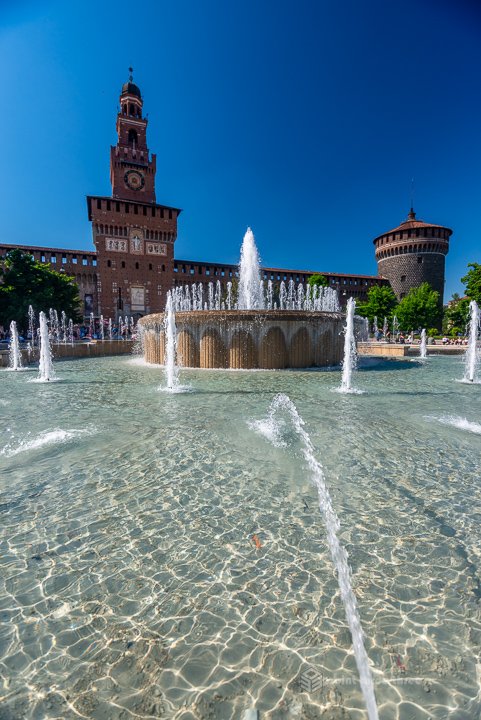
Castello Sforzesco was very nice. It is a 15th-century fortress housing Michelangelo’s final sculpture.
We missed Leonardo da Vinci’s Last Supper. Located in the refectory of Santa Maria delle Grazie convent, this Renaissance masterpiece is one of Milan’s most sought-after attractions. This was closed during our visit – don’t make our mistake! Book early if this iconic painting is on your Italy photography bucket list.
To help with your Milan planning you can also visit the cities official website here : https://www.yesmilano.it/en/traveller-information/getting-around
Ferrari & Lamborghini Museums
Between Milan and Bologna lies Italy’s “Motor Valley” – home to legendary automotive manufacturers including Ferrari, Lamborghini, Maserati, and Pagani. These museums make essential stops for enthusiasts and car lovers.
Ferrari Museum (Museo Ferrari), Maranello
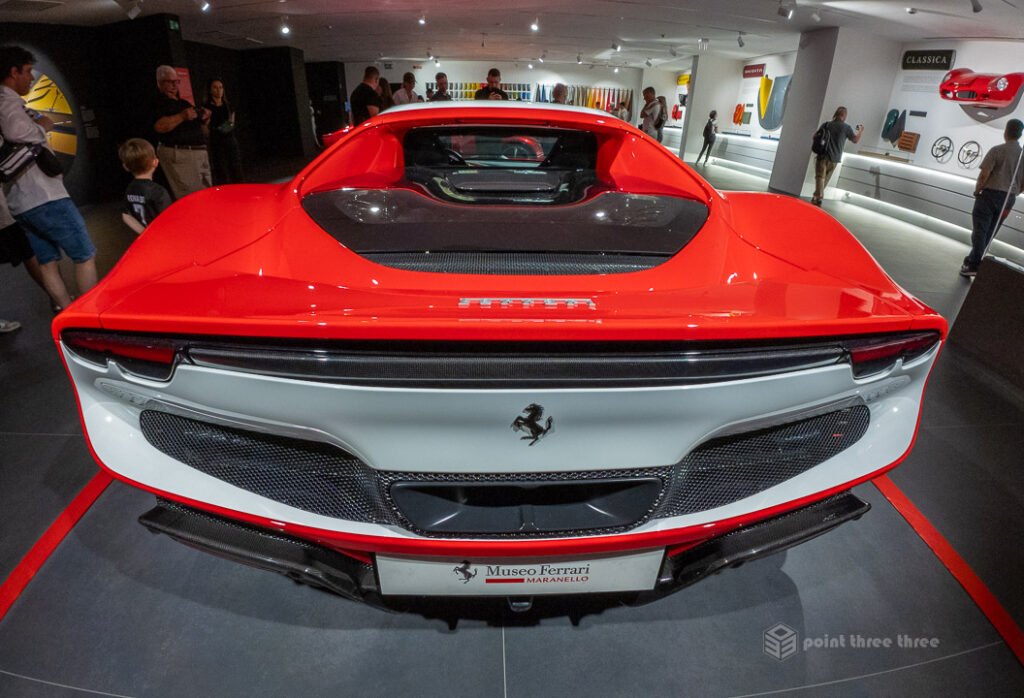
You can find the main link to Ferrari’s museums here : https://www.ferrari.com/en-EN/museums/ferrari-maranello
The museum displays Ferrari’s iconic cars including : 250 GTO, F40, LaFerrari, Formula 1 champions and a lot more. It also has interactive exhibits and F1 simulators available.
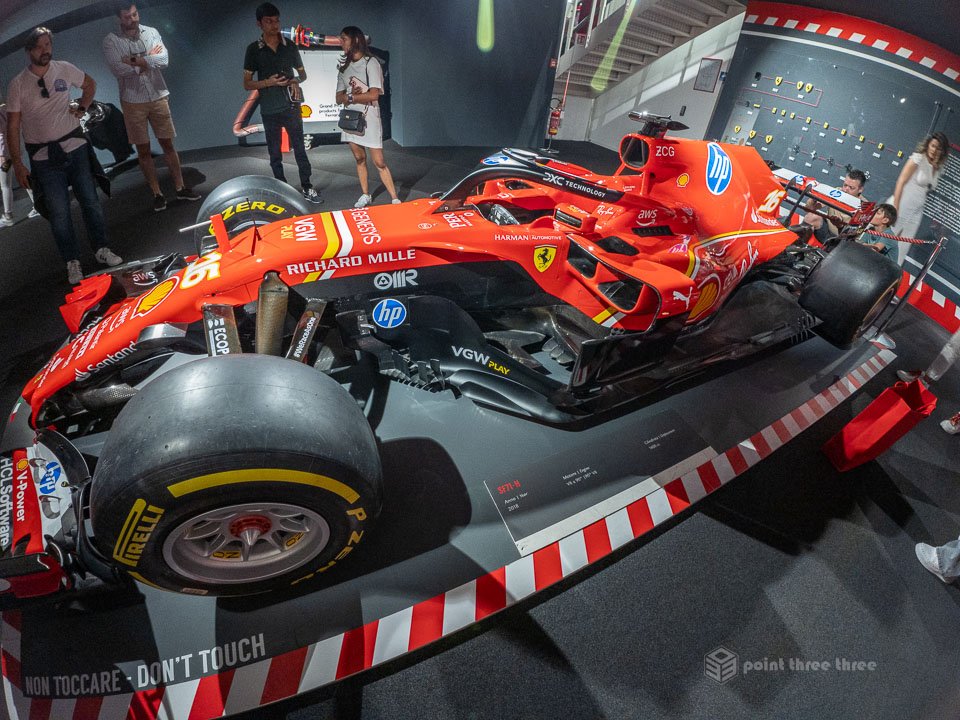
I took a photo op with my son sitting a Ferrari. A bit cliché but a nice memory.
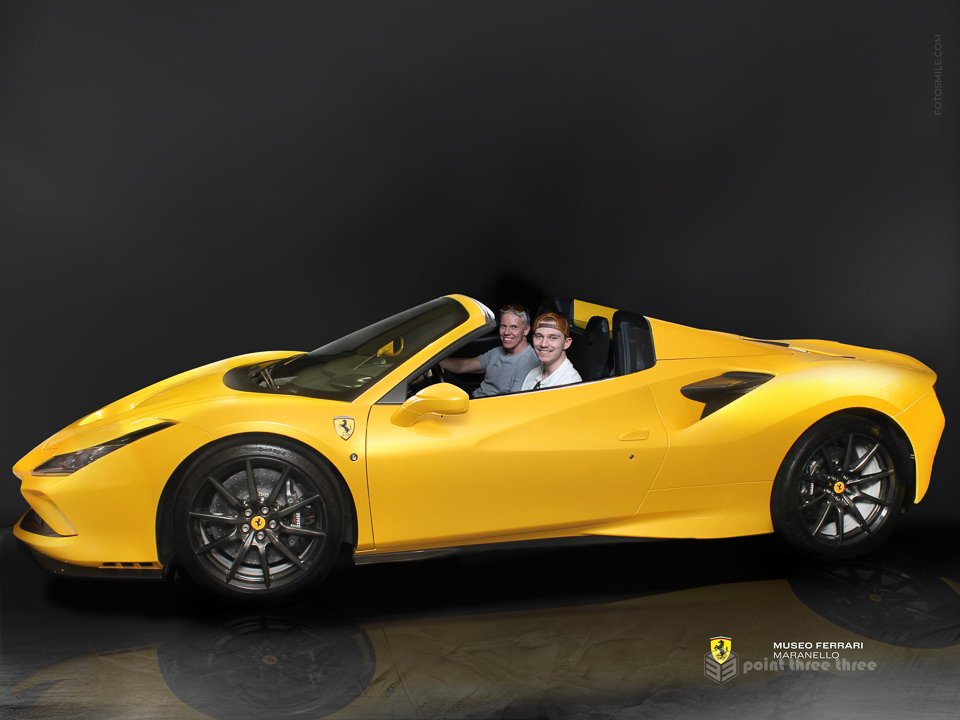
Factory tours require advance booking (we missed these!)
Follow this link for details: https://www.ferrari.com/en-EN/museums/factory-tour
For tickets and packages you can follow this link: https://www.ferrari.com/en-EN/museums/ferrari-museums-visit-tickets-packages
Don’t confuse the Maranello museum with Modena. Yes, there are two locations! The Modena location details are here : https://www.ferrari.com/en-EN/museums/enzo-ferrari-modena
Lamborghini Museum (Museo Lamborghini), Sant’Agata Bolognese
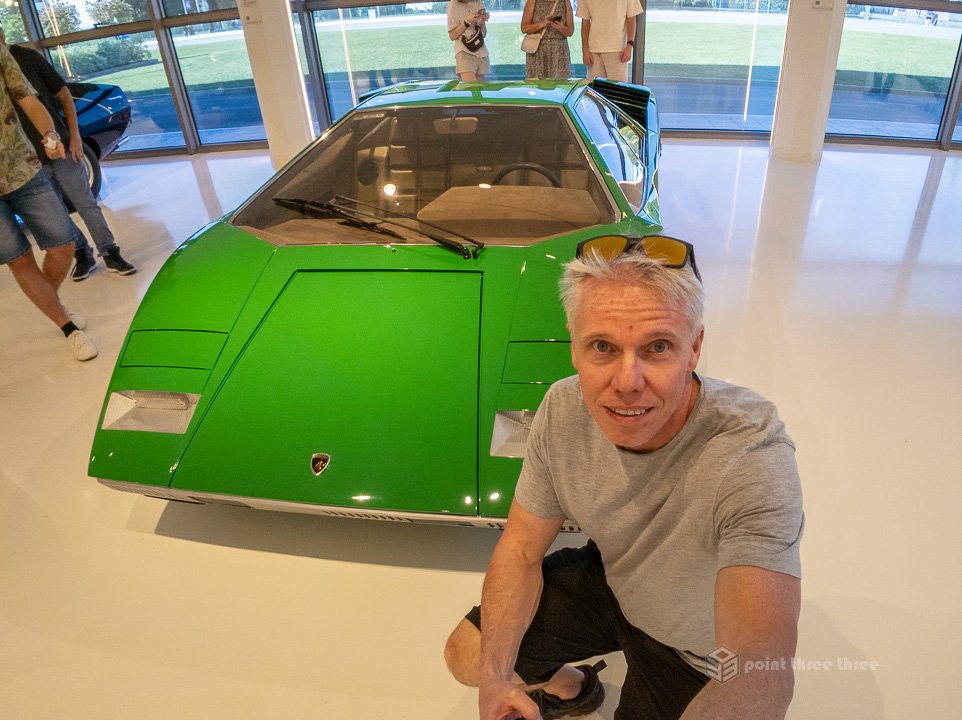
I had a poster of the Lamborghini Countach on my wall as a teenager. I was not going to miss the opportunity to visit Sant’Agata, where the iconic car of the 80’s was made.
The museum showcases the evolution from Miura to modern Aventador and Huracán
It is a very different experience compared to Ferrari. Much smaller and less crowded – more intimate experience. As with Ferrari you will want to book your factory tour earlier as we had missed this.
For Museum details, visit their website here : https://www.lamborghini.com/en-en/museum#val-tab
Bologna
Bologna surprised us as one of Italy’s underrated destinations. Known as “La Dotta, La Grassa, La Rossa” (The Learned, The Fat, The Red) – referencing its ancient university (founded 1088), exceptional cuisine, and terracotta architecture – Bologna offers authentic Italian experiences without overwhelming tourism.
Bologna’s Two Towers (Le Due Torri ) – Asinelli (97.2m tall) and the leaning Garisenda (48m) – define the city’s skyline. In medieval times, Bologna had nearly 100 towers built by wealthy families as symbols of prestige and defense; today only about 20 remain. The leaning tower of Pisa gets all the fame, but I was very surprised when I first witnessed the angle the tower was leaning.
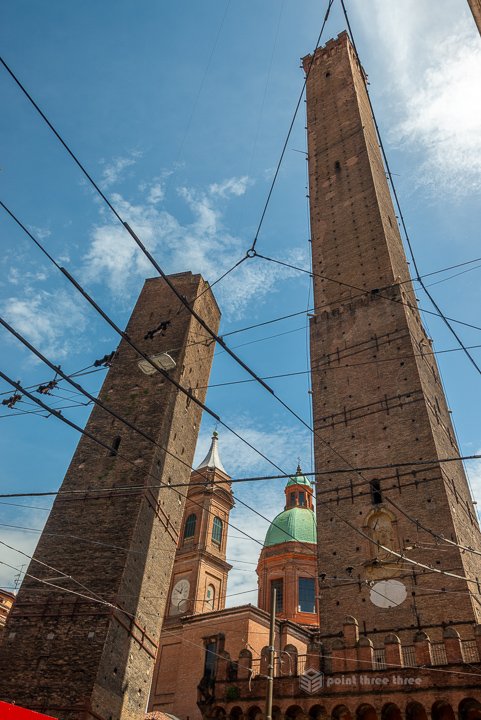
The buildings are not easy to photograph. They were also under construction so the focus was simply to capture the moment. While you can tour them, our time was too compressed in Bologna so we had to pass.
Other worthwhile locations to visit, even if you are on a tight time budget like we were include:
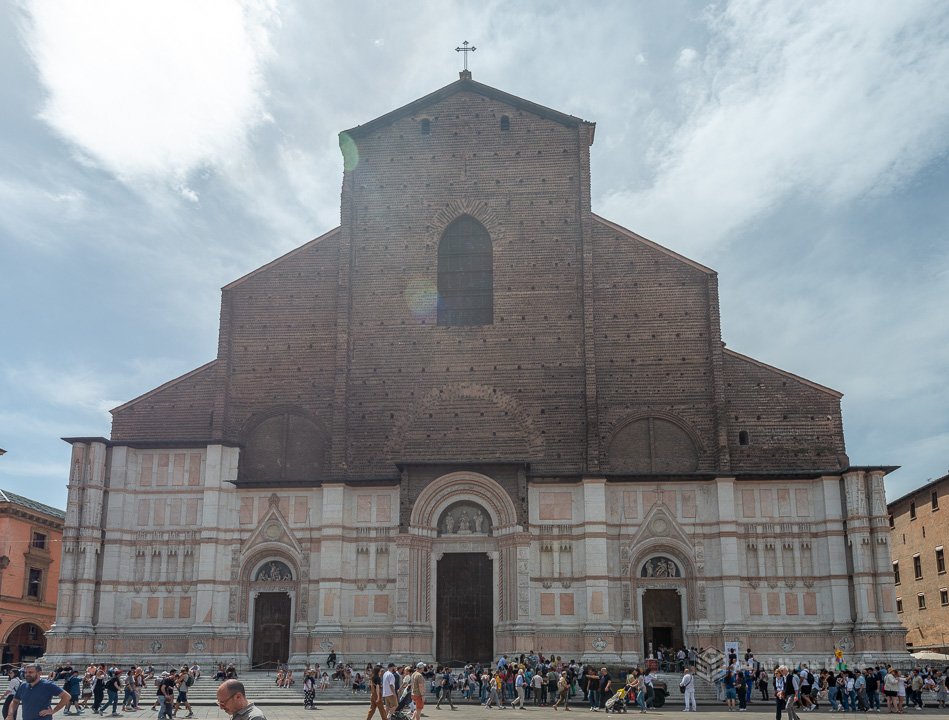
Piazza Maggiore – Medieval square surrounded by Palazzo d’Accursio, Basilica di San Petronio, and Palazzo del Podestà. Best photographed during golden hour when warm light enhances terracotta buildings.
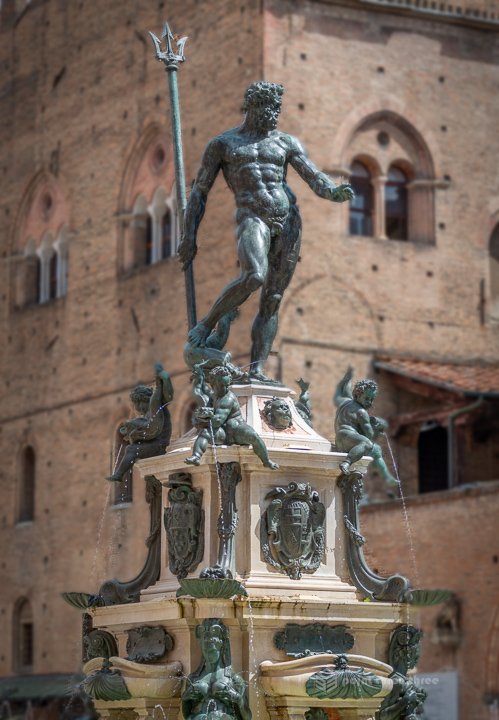
Neptune Fountain (Fontana del Nettuno) – Magnificent 1566 bronze fountain by Giambologna. I took a variety of angles, shooting from low angles emphasizes Neptune’s imposing stature. I did not have the opportunity, but blue hour would provide dramatic backlighting.
The University of Bologna (Università di Bologna, Unibo), founded in 1088, is the oldest university in the Western world, renowned as the first higher-learning institution. Located in Italy, it is famously known as the Alma Mater Studiorum and is recognized as the oldest university in continuous operation.
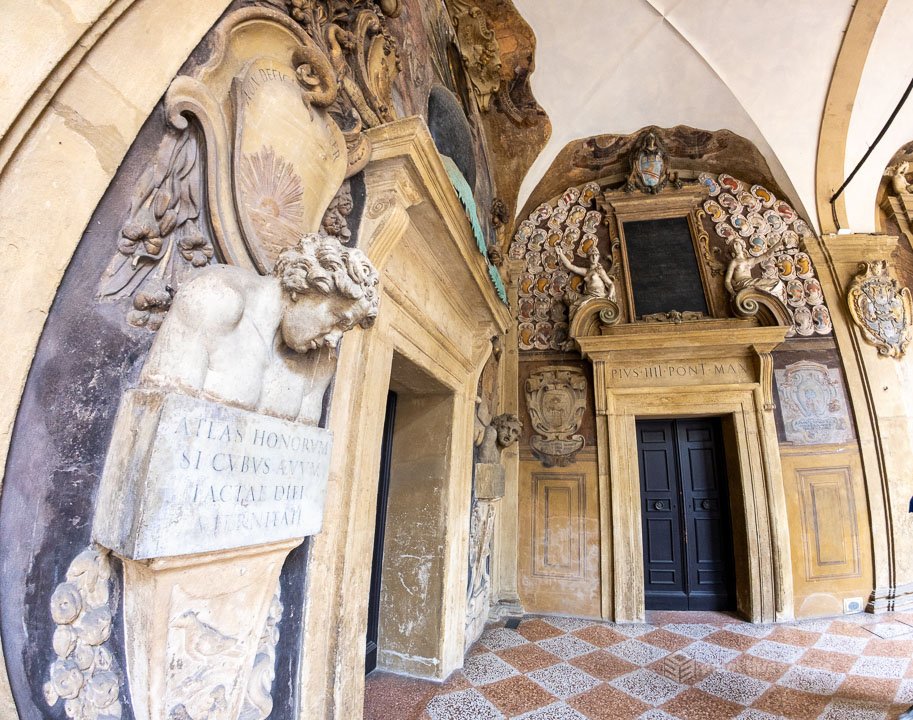
Archiginnasio Palace was built in 1563, this served as the university’s main, centralized location until 1803.
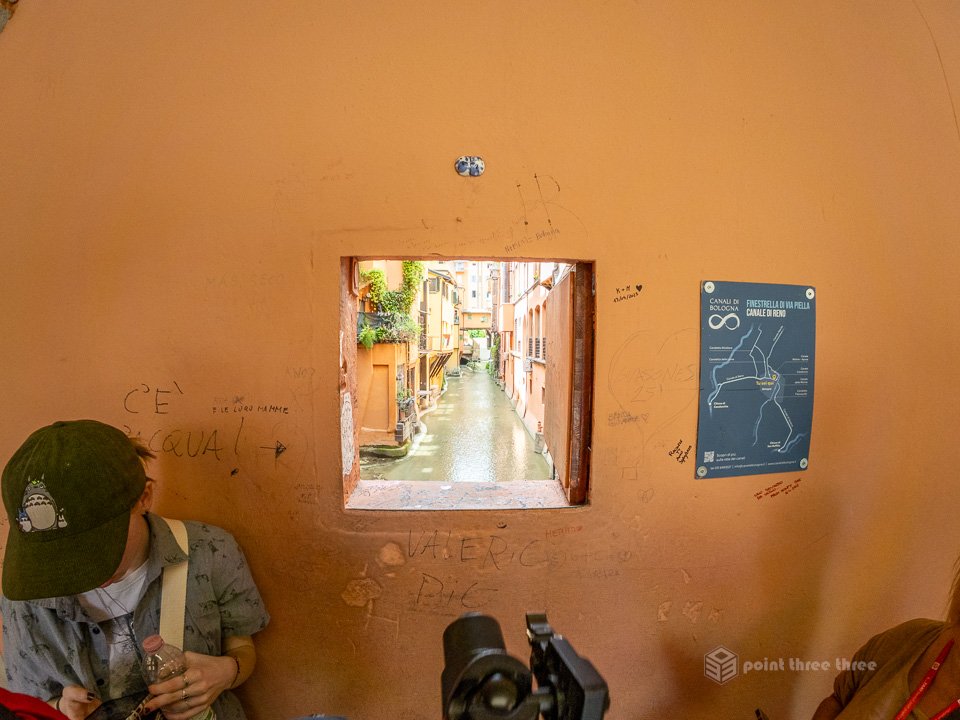
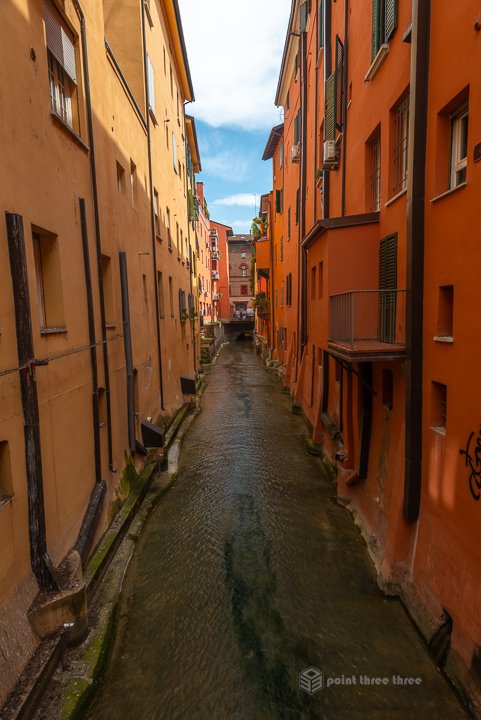
Bologna Practical Tips for a short duration visit
Hotel : If you have a vehicle and only less than a day, you can save some money and pick a location further away from the city center. We picked close to the airport and parking overnight was no problem at all.
Travel into the city center : We parked at Parcheggio Tanari (near Bologna Centrale train station). It was a reasonable 25-minute walk to historic center through porticoes. We were lucky that the day we were there, it was even free parking. Alternatively, you can get closer and park near Piazza Maggiore which means navigating the city and of course more expensive.
The official website of Bologna city for visitors is bolognawelcome.com, which acts as the primary portal for tourists, offering guided tour bookings, event tickets, and travel information.
Cinque Terre: Dramatic Coastal Villages (3 Nights in La Spezia)
Cinque Terre (Five Lands) encompasses five UNESCO World Heritage fishing villages perched dramatically on the Italian Riviera coastline: Riomaggiore, Manarola, Corniglia, Vernazza, and Monterosso al Mare. These colorful villages offer some of the Mediterranean’s most spectacular coastal photography. When we were planning our trip, this was a must-have location.
For Hotel and Base location we actually chose La Spezia. Some of the rationale was:
-
- We had a rental car and you can not drive into the small towns. So it complicated overnight parking locations.
-
- Cost – as we booked a bit late, it was just cheaper to get an AirBnB in La Spezia and we had some more options.
-
- Transportation – We were very close to the train station, so getting into Cinque Terre was no problem at all. Furthermore, as I wanted to explore most of the towns, we would have needed to get the train tickets and travel anyway.
-
- That being said, parking was also difficult in La Spezia and we had to park at a location about a km away from the hotel.
The Train System
Regional trains (Trenitalia) connect La Spezia to all five villages with 15-30 minute frequency:
La Spezia → Riomaggiore (closest town) is about 8 minutes and La Spezia → Monterosso (farthest town) is about 25 minutes.
We followed a lot of the other recommendations online and leveraged the Cinque Terre Card for Unlimited train travel between La Spezia and the 5 villages.
For the hiking and train card, you can find more information here : https://card.parconazionale5terre.it/en
Manarola
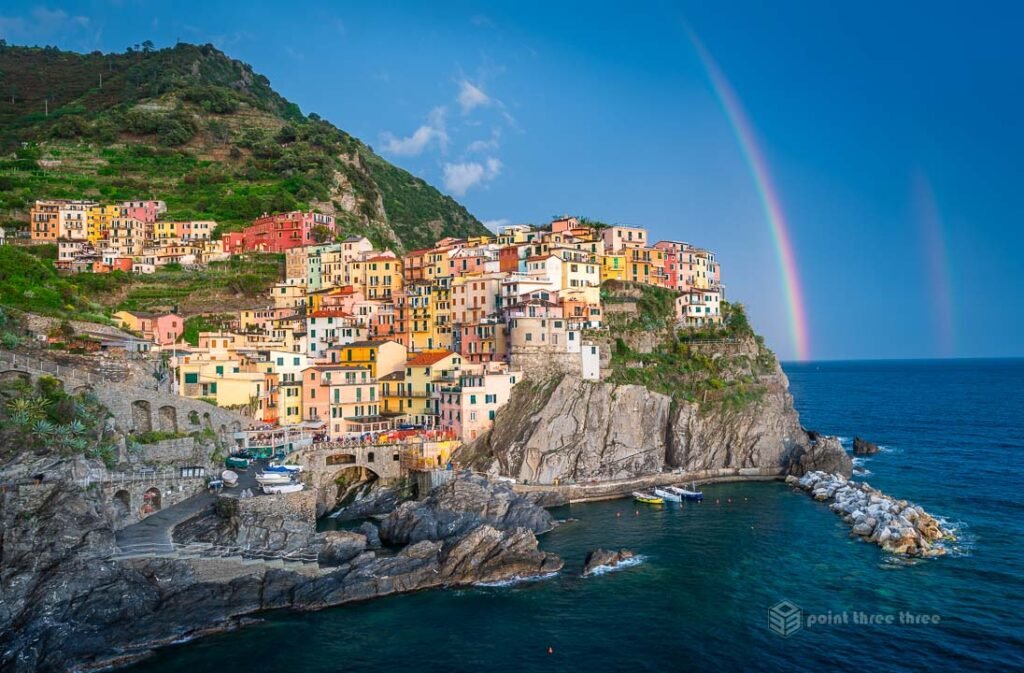
Manarola is arguably the most photographed location in all of Cinque Terre. The classic sunset view showing colorful houses stacked vertically on the cliff has been on countless Italy photography bucket lists – including mine for years. If you have only one evening and sunset, this is the location. It did not disappoint, it was lovely!
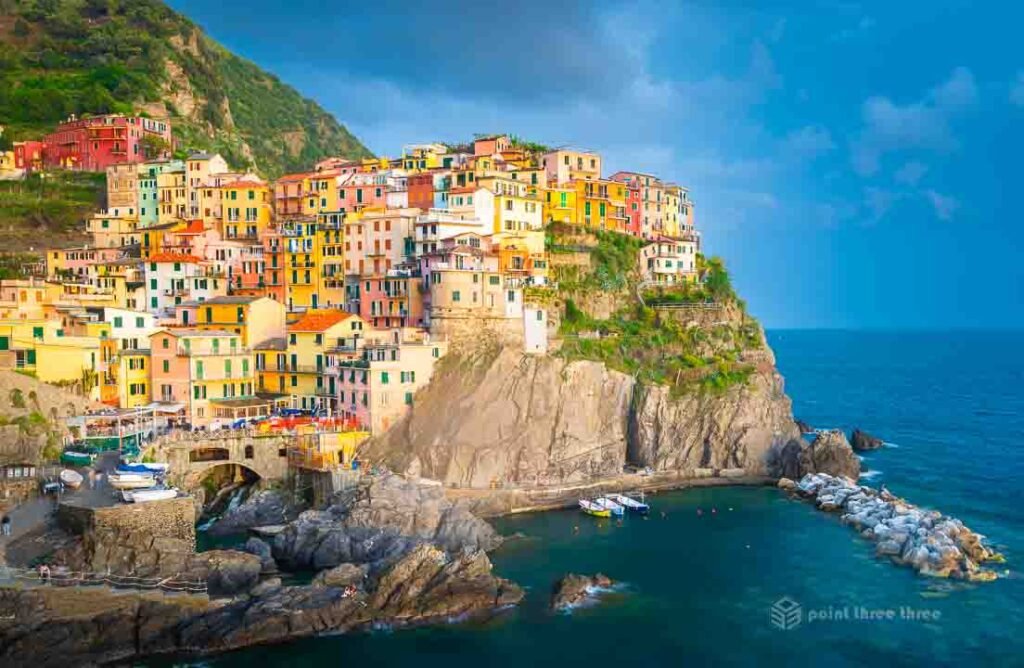
My favorite image from this location is this blue hour capture.
Vernazza: The Most Beautiful Village
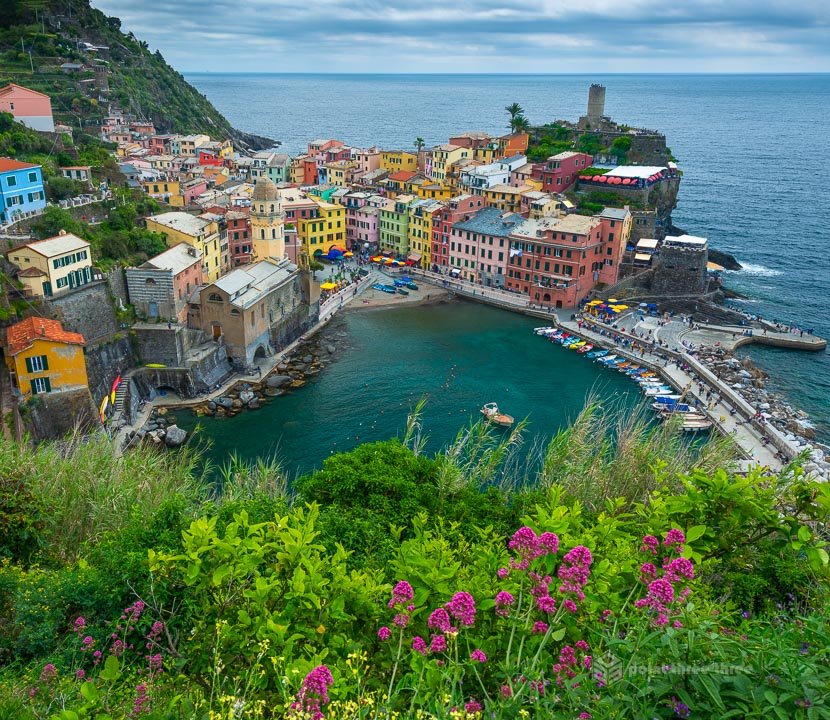
Many consider Vernazza the most charming of the five villages. It’s the only village with a natural harbor, making it historically the most important fishing port.
Riomaggiore
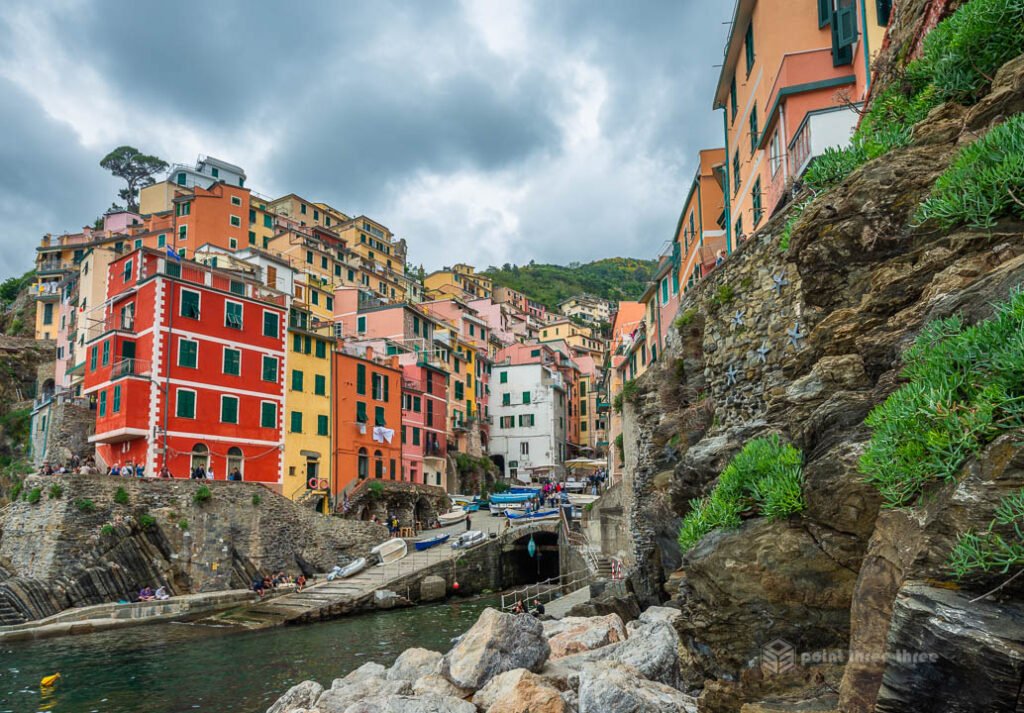
Riomaggiore is the southermost of the five villages.
Monterosso al Mare (northernmost, largest village)
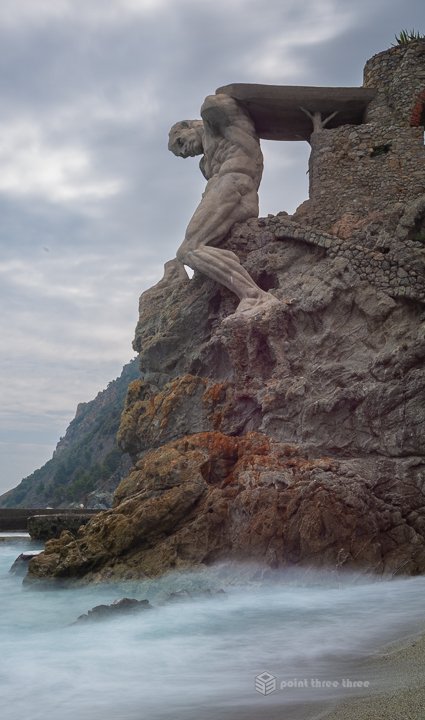
Monterosso is the only village with sandy beach – great for beach/coastal photography.
You can find the official website of Cinque Terre here : https://www.cinqueterre.it/en/
Tuscany: Val D’Orcia Photography Paradise (3 Nights)
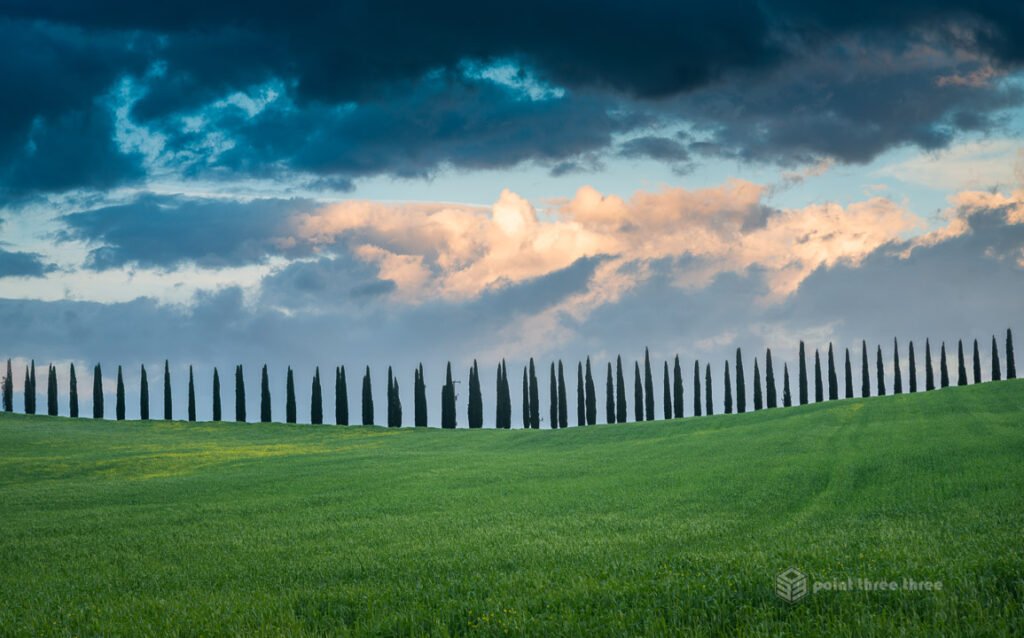
Val d’Orcia represents quintessential Tuscany – the rolling hills, cypress trees, isolated farmhouses, and golden wheat fields that inspired Renaissance painters and continue captivating photographers, including myself. This UNESCO World Heritage landscape in southern Tuscany deserves dedicated time for any Italy itinerary that includes photography.
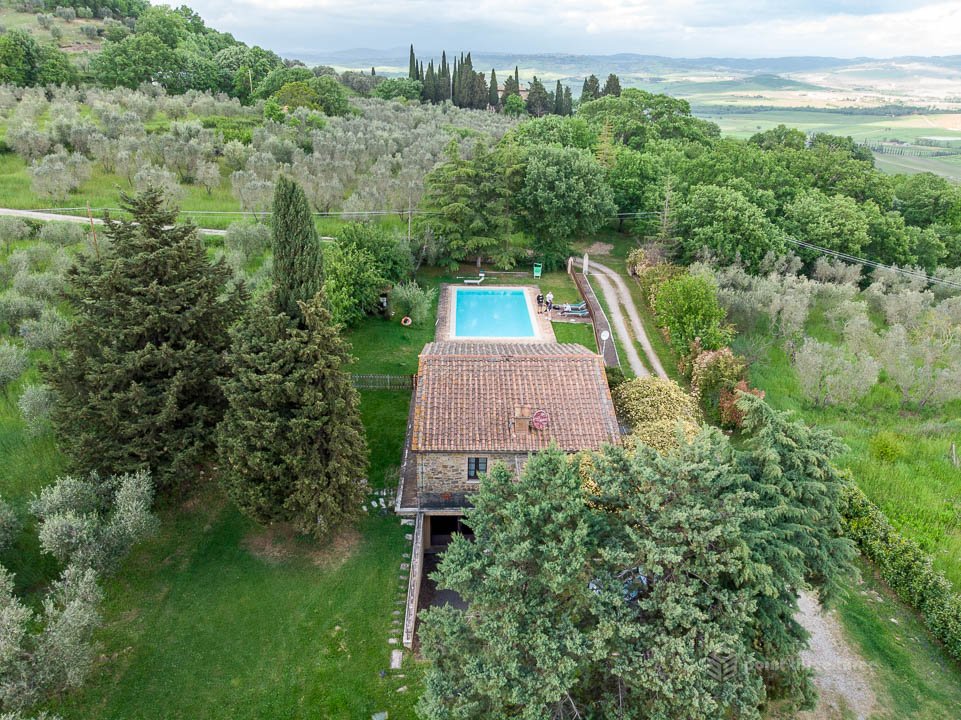
While Florence, Siena, and Pisa are essential Italian cities (which we’d visited previously), Val d’Orcia offers the iconic Tuscan countryside that most people envision: gentle hills, perfectly positioned cypress trees, winding roads, medieval hilltop towns, and geometric agricultural fields that change dramatically with seasons. We rented a villa near Castiglione d’Orcia, strategically chosen for central access to Val d’Orcia’s iconic photography locations. This was probably our best hotel/room pick, it had a central location to all major photo spots (15-45 minute drives), Kitchen facilities, Pool that family relaxed by, no parking issues and we were secluded on our own property.
I have a more detailed blog on photo locations with GPS coordinates in this blog, click here.
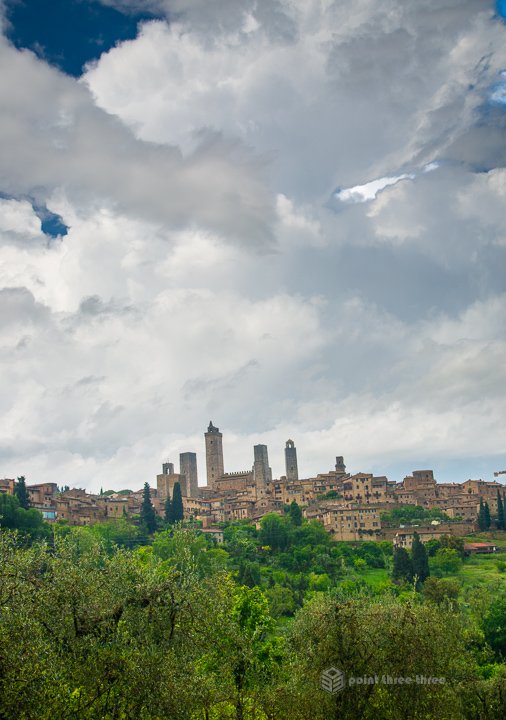
San Gimignano: Manhattan of the Middle Ages
We made a detour on our drive from Cinque Terre to our hotel in Val D’Orcia to view this wonderful town.
Its famous for its medieval tower houses that create a unique skyline. It’s a UNESCO World Heritage site with 14 remaining towers (originally 72).
At 14th-century peak, wealthy families competed building defensive towers. Important stop on Via Francigena pilgrimage route to Rome.
We did not have time to explore the small city but will do on our return trip. It was still worth it to view its splendor for its permitter where I took the above photo.
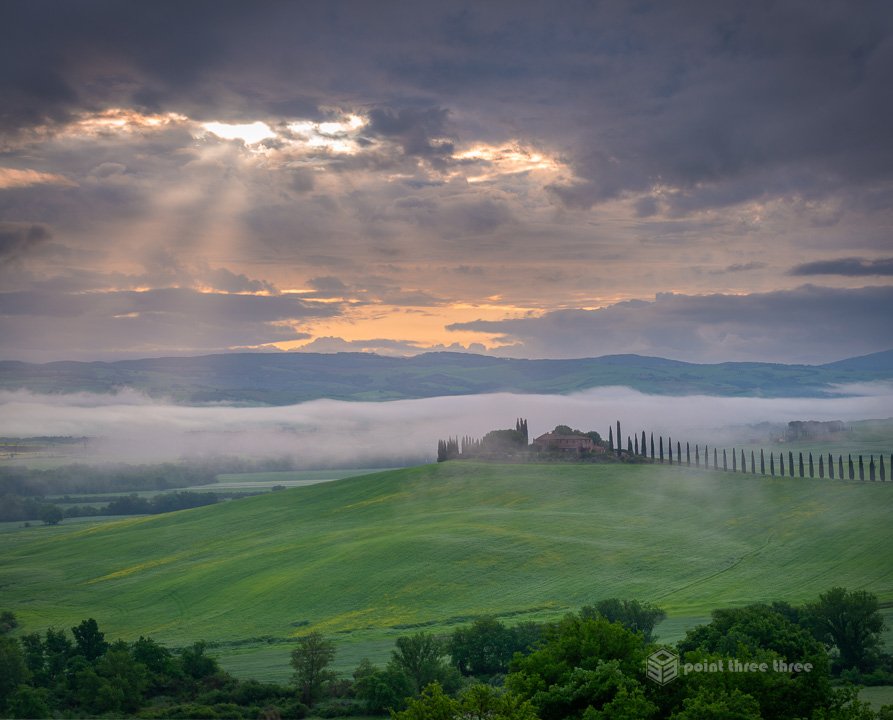
Poggio Covili: The Most Photographed Tuscan Farmhouse
This is one of the iconic Tuscany locations to view. A lone farmhouse atop rolling hills surrounded by perfectly positioned cypress trees. This location has appeared in countless publications, calendars, and inspired thousands of photographers.
Cipressi di San Quirico d’Orcia: Famous Cypress Grove
The Cipressi di San Quirico d’Orcia are world-renowned, and there are actually two distinct groups on that same hill—the “Lower Grove” (the cluster) and the “Upper Circle.
Safety Note: Parking is very limited in this area. I saw several tourists do very dangerous parking and u-turns. Respect the locals and follow common sense.
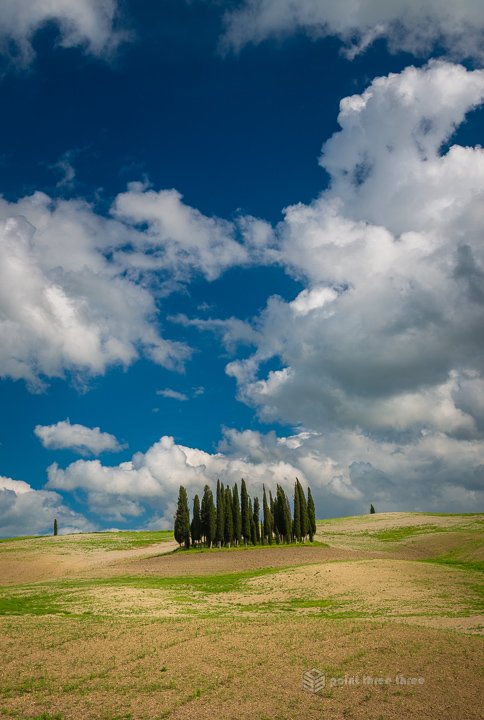
See also my photo: Iconic Tuscan Cypress Grove
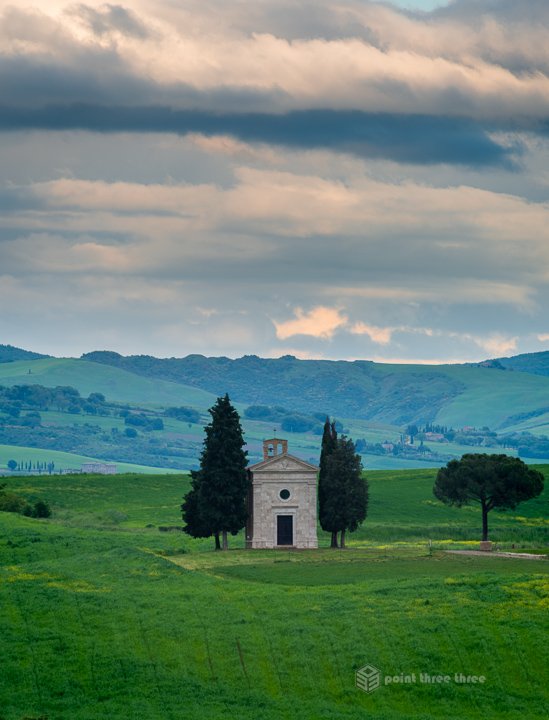
Chapel of Madonna di Vitaleta: Renaissance Perfection
Perhaps the most iconic building in Val d’Orcia, this tiny Renaissance chapel sits alone on a hilltop surrounded by cypress trees and rolling wheat fields. Featured in countless Italy photographs, films, and advertisements.
Historical Context: Built in 1590s, replacing earlier medieval church. Dedicated to the Virgin Mary, exemplifies Renaissance ideals of harmonious proportion within landscape. Still consecrated, occasionally used for services.
Podere Belvedere: Quintessential Tuscany
A Tuscan farmhouse among lush green rolling hills and cypress trees, this is what my dreams of Tuscany see. I truly is a beautiful setting.
This is definitely a sunrise location and if you go there, you will likely be accompanied by several other photographers and tripods.
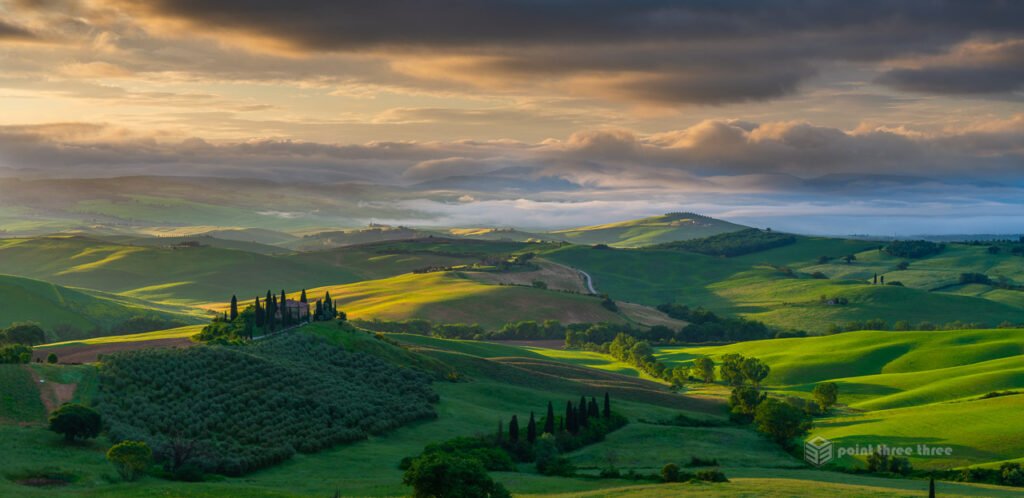
See also my photo: Podere Belvedere Sunrise
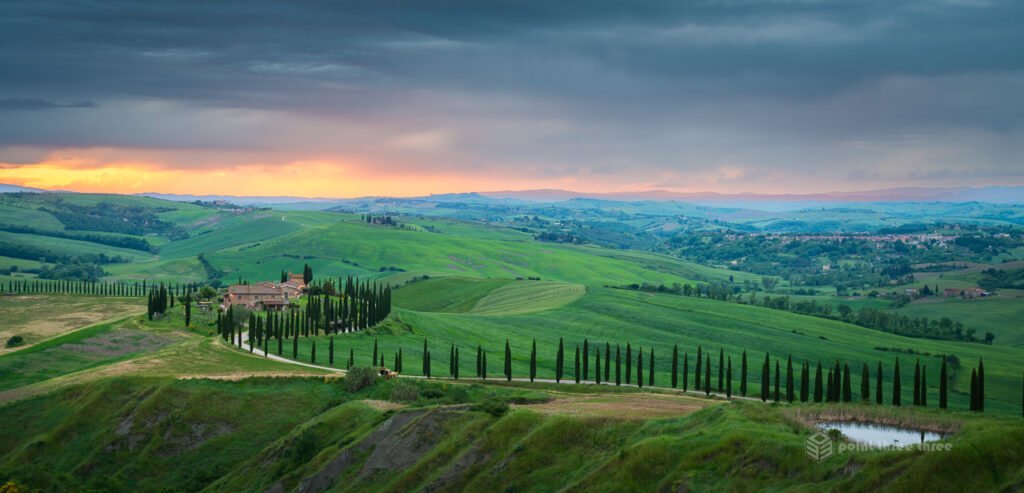
Agriturismo Baccoleno: The S-Curve Cypress-Lined Road
Dramatic dirt road lined with tall cypress trees leading to farmhouse on hilltop. Offers strong leading lines and dimensional perspective.
This was probably one of “the” photos sought after in the region. Alas, the owners likely grew tired of ignorant tourists and have fenced off a portion to the property restricting your views. While I was disappointed, I can’t say I blame them. You can no longer take the classic “s-view” leading to the farm house. This is the best that I could achieve. The one positive, is I was at the location by myself.
Val d’Orcia area Towns Worth Visiting
Pienza: The Ideal Renaissance City
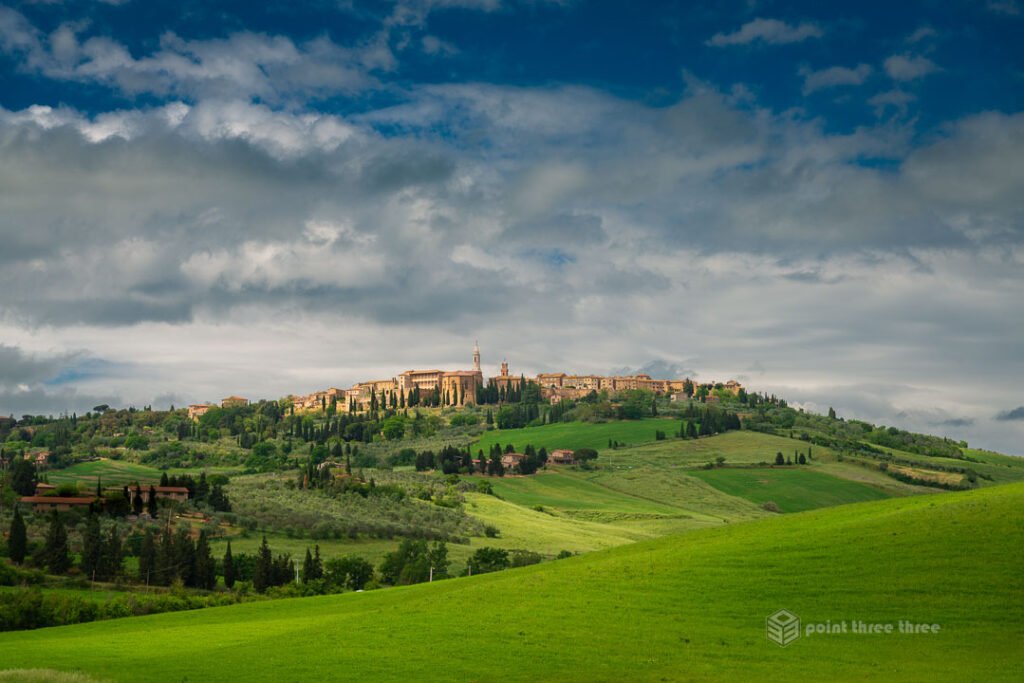
UNESCO World Heritage site transformed from village to “ideal city” by Pope Pius II in 1459. Perfect example of Renaissance urban planning.
The family loved walking through this small city. Even though it rained on us, it did not dampen our visit as we spent half day wandering the cobblestone streets, shops and fine food. It felt like the opposite of the hustle or Rome.
Civita di Bagnoregio: The Dying City
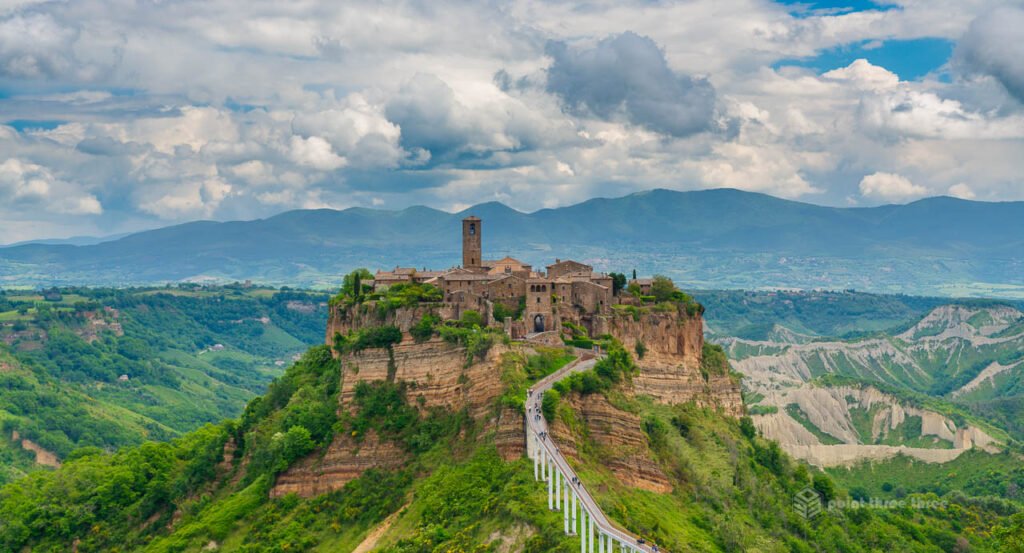
Dramatic hilltop village accessible only via 300m pedestrian bridge. Called “La Città che Muore” (The Dying City) – volcanic tuff hill slowly eroding.
Founded by Etruscans 2,500 years ago. Earthquakes and erosion have isolated it. Today only 6-11 permanent residents, though popular with tourists.
We made a detour stop to this location on our drive to Rome. It was well worth it. We did not have time to hike to the hilltop village but still worth the trek to view this amazing location. It was a fairly easy drive to the location and at the time we arrived, ample parking which is close to the viewpoints.
Rome: The Eternal City (4 Nights)
Rome layers 3,000 years of history from ancient ruins to Renaissance masterpieces to modern Italian life. This was our second family visit to the amazing city and it did not disappoint. They say you can see Rome in a day, and I don’t think of seen enough after two trips! It’s a city that overwhelms in the best way.
Rental Drop-off and getting into Rome
Our first task was dropping off the rental car at Rome Fiumicino Airport (FCO). Navigating the airport for the first time was a bit of challenge. You best option in my opinion getting into the city is taking the Leonardo Express Train. It’s a bit more expensive than local trains but gets you non-stop to Rome Termini station. There were kiosks and windows that made purchase relatively easy.
Official website of Trenitalia Leonardo express : https://www.trenitalia.com/en/services/leonardo-express.html
Rome Accommodation and getting around Strategy
As a family, we will tend to do a lot of walking when we hit a city like Rome, Paris or London. So we wanted to target a location that would be central enough to minimize the need for transit.
We opted for an AirBnB near the Spanish steps. Which conveniently also has the Spagna Metro line there.
The main locations we wanted to visit included: Vatican City, St Paul’s, Pantheon, Piazza Navona, Colosseum, Roman Forum, Spanish Steps, Monument to Victor Emmanuel II, Castel Sant’Angelo, Trevi Fountain, Capitoline Museum
While we are ok with walking, we still wanted to minimize the necessary number of steps to jump out to each location.
Cautionary Note : While we had a decent location, our rooms did not match the photo quality/expectations – lesson learned about reading recent reviews carefully.
Walking times to some of the locations we knew we were going to visit were reasonable :
– Spanish Steps –> Ponte Umberto 15min
– Spanish Steps –> Pantheon about 15min
– Spanish Steps –> Vatican City was about 40min.
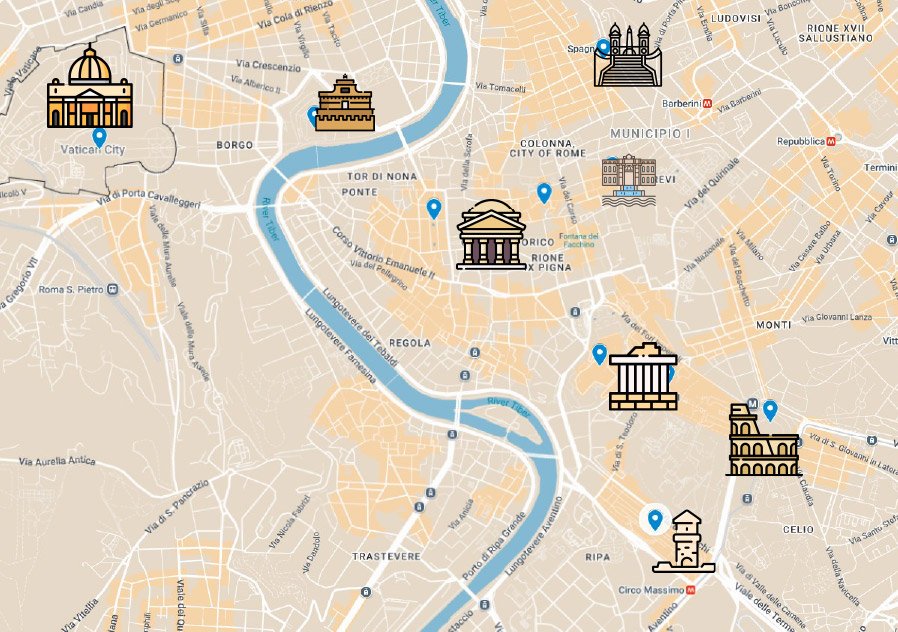
When going to the Colosseum which we did twice, we took the Metro. But walked back as we hit the Roman Forum and Monument to Victor Emmanuel II on our way to the hotel.
The Metro was easy to navigate but its reach is nothing like London or Paris. Really two lines for getting around to the main sites in my opinion. That being said, it was easy to navigate and we never found the need to get an Uber or equivalent.
Information on public transport and mobility services provided by Atac is here : https://www.atac.roma.it/en
High level Rome Itinerary of main attractions
Day 1 (May 8th) : Arrive in the afternoon – Hotel Check-in, Spanish Steps, Sunset at Ponte Umberto
Day 2 (May 9th) : Vatican Museums and St. Peter’s Basilica, Sunset at Spanish Steps (view of St. Paul’s)
Day 3 (May 10th) : Capitoline Museum, Circus Maximus, Monument to Victor Emmanuel II, Sunset at Colosseum
Day 4 (May 11th) : Pantheon, Temple of Hadrian, Piazza Navona, Castel Sant’Angelo, Sunset at Roman Forum
Day 5 (departure) : Early morning at Trevi Fountain, depart for FCO airport.
St. Peter’s Basilica from Ponte Umberto
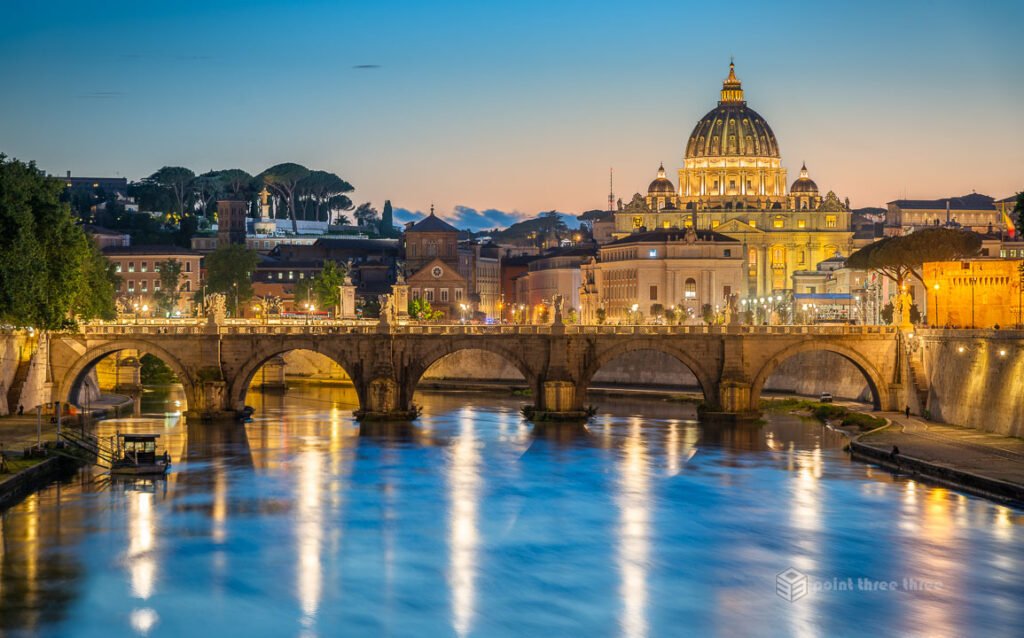
See also my photo: Ponte Umberto I and St. Peter’s Basilica in Black and White
Our first evening we had a relaxing walk from our hotel down to Ponte Umberto. I had taken a photo here prior and wanted to re-create that composition at Blue Hour, just after sunset.
Interesting note – that evening we noted a bunch of helicopters flying around and realized the white smoke had just came from the conclave as they had selected the new pope!
Vatican: Museums, Sistine Chapel & St. Peter’s Basilica
Just stating the obvious… this is another Must-Do while visiting Rome.
You will want to budget most of the day to do justice to this amazing location!
*Start Early*, that is get there before gates open. Better yet, I highly recommend you book a tour to allow you to get to the front of the entrance line quicker! We rented the audio guide for the museums so the tour operator’s primary purpose was to get us in as quickly as possible.
Our recommended strategy for route is : Museums → Sistine Chapel → exit to St. Peter’s Basilica.
Sadly for us, the Conclave for the new Pope had not concluded so we could not get into the Sisteen chapel.
Vatican Museums
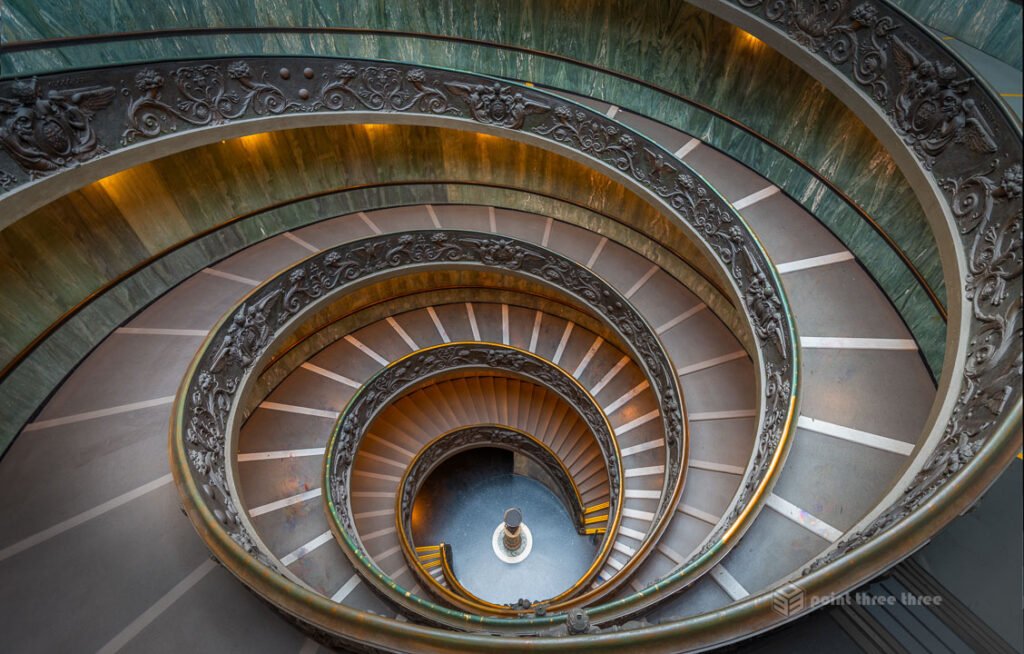
One of the most visited art museum complexes in the world, housing centuries of papal collections. It is overwhelming to take in. Even though we were not in peak season, it was very busy. If you are a fan of museums you could literally spend an entire day wandering this amazing site.
St. Peter’s Basilica
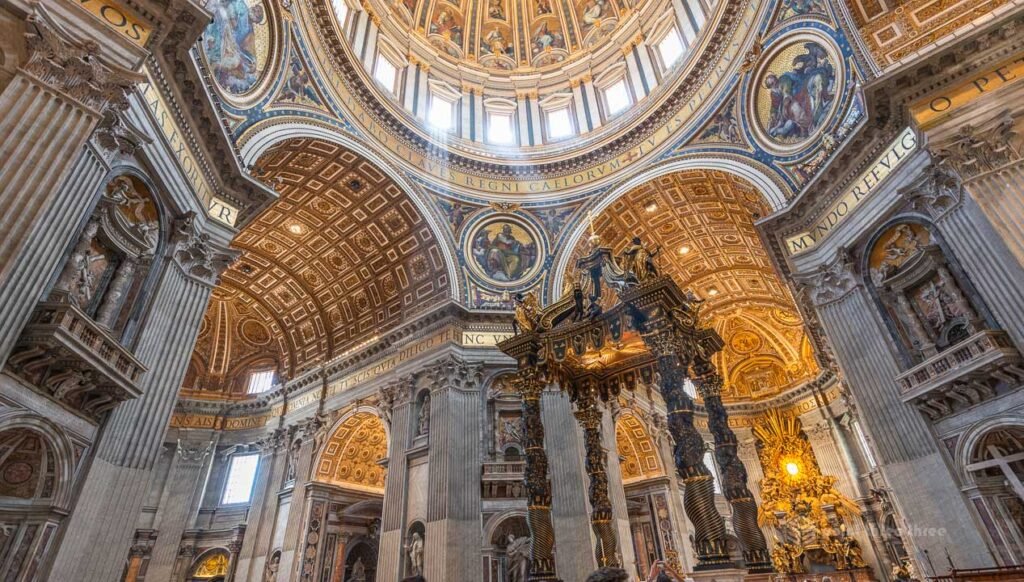
Located at the heart of Vatican City, St. Peter’s Basilica is widely regarded as one of the holiest shrines in Christendom and is the largest church in the world by interior measure.
It has religious significance since built over the presumed tomb of St. Peter (one of Jesus’ twelve apostles and the first Pope), the current basilica was completed in 1626. It replaced an older 4th-century structure commissioned by Emperor Constantine.
It was awe inspiring to view this architectural masterpiece. The building is a triumph of Renaissance and Baroque architecture, featuring contributions from masters like Bramante, Michelangelo (who designed the iconic dome), Raphael, and Bernini.
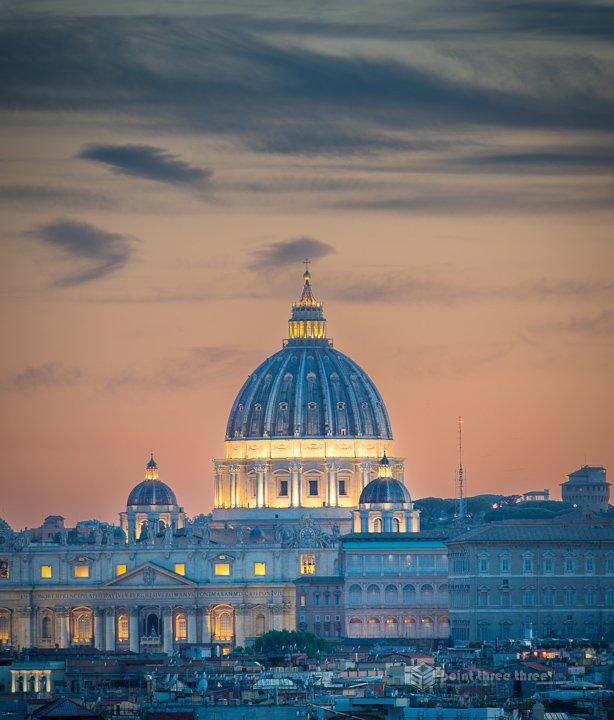
Unfortunately, the Dome Climb was not available to us, but we would have taken this as the views are amazing.
The official website of the Vatican Museums : https://www.museivaticani.va/content/museivaticani/en.html
The Colosseum
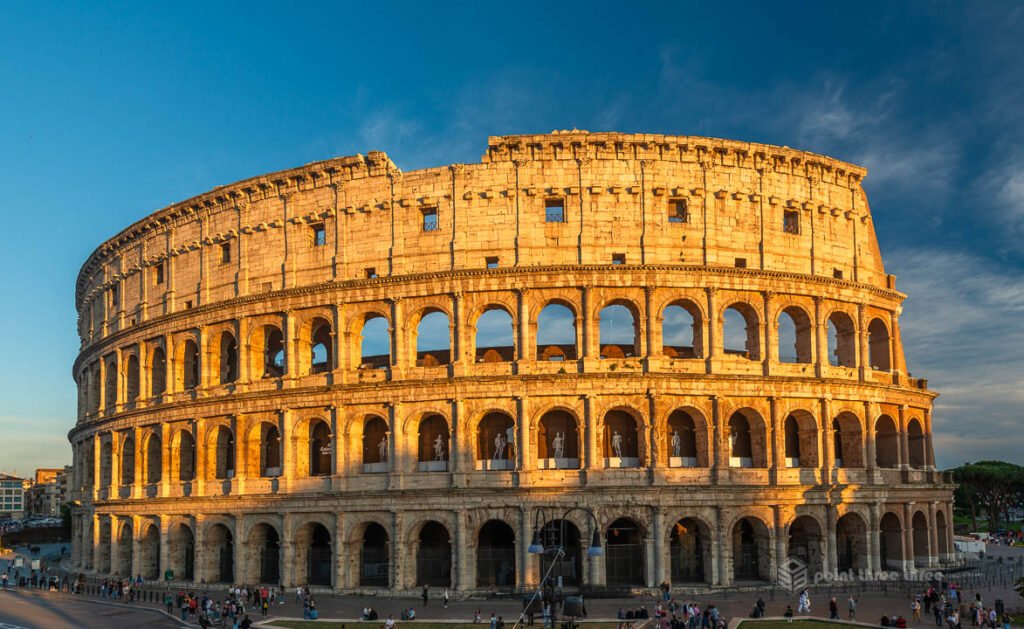
See also my photo: Roman Colosseum at Blue Hour
The Colosseum (Flavian Amphitheater) in my opinion is Rome’s most iconic ancient monument. Built 70-80 AD, this massive amphitheater held 50,000-80,000 spectators for gladiatorial contests.
We finished off our 3rd day of attractions at the Colosseum during Blue Hour.
Getting There: Take the Metro Line B (Blue Line) directly to the Colosseo station, which is located right in front of the monument. Or you can walk 😊
We did not tour the Colosseum on this trip as we had done that prior. It’s a must-do when you visit Rome! Plan in advance! Our first trip we came in on a cruise and it was a national holiday and the line ups were absolutely insane. This is one of those locations where purchasing a tour that gets you in quickly and as well gives you a lot of context and background was worth it.
For this trip, it was just taking in the spectacle and walking around the entire site.
I chose to focus on Blue Hour to photograph it. Personally I think it is the most iconic view of this monument. Located just north of Arch of Constantine and the Roman Forum to your back.
Official website for booking your tickets: https://ticketing.colosseo.it/en/
Roman Forum
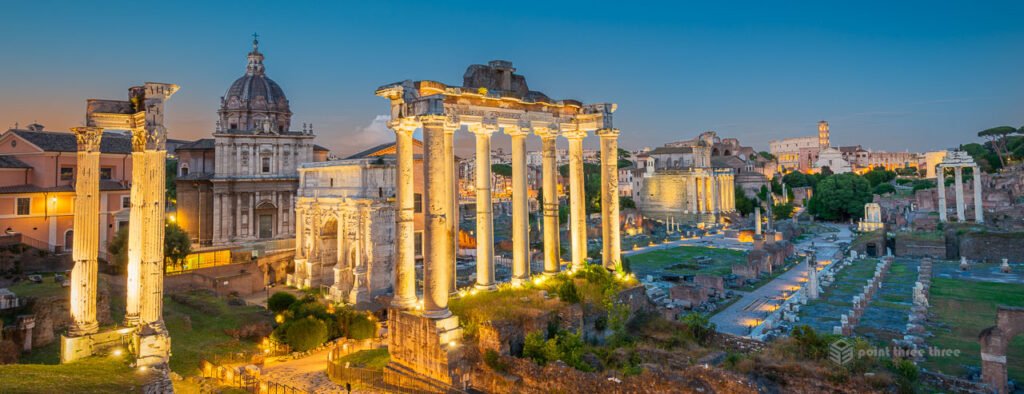
The Roman Forum was the former center of Roman public life – marketplace, political hub, religious center. Extensive ruins offer many photographic compositions.
Its an amazing ruin, however, we did not pay for the entrance fee on this trip as we had already done it before, but some of your best views to view the ruins are from Capitoline hill.
There is however a great location that is 100% free and amazing to view the ruins with the Colosseum in the background. Head to Via Monte Tarpeo which is a small street behind Piazza del Campidoglio. Wait for 30 minutes after sunset and you can get the same view as the picture above.
Planning your visit, you will probably want to couple this with the Colosseum since they are right beside each other.
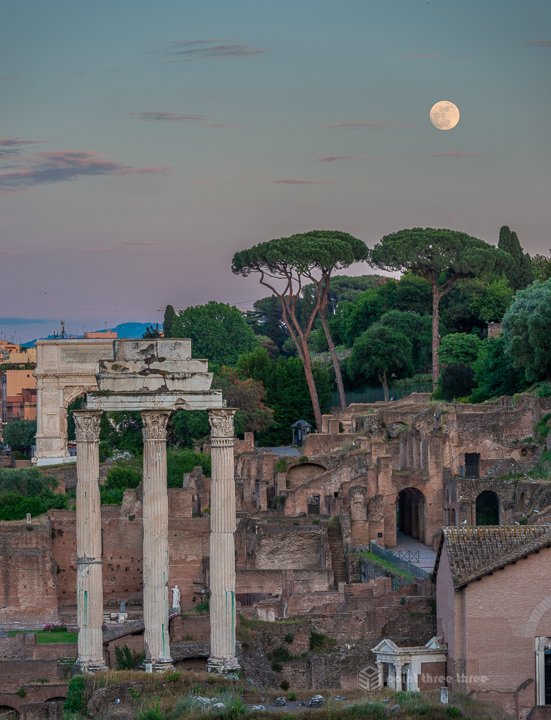
My favorite blue hour image of the Roman Forum is here.
For ticketing and planning, this is the link from the official website : https://colosseo.it/en/opening-times-and-tickets/
Pantheon – Best-Preserved Ancient Building
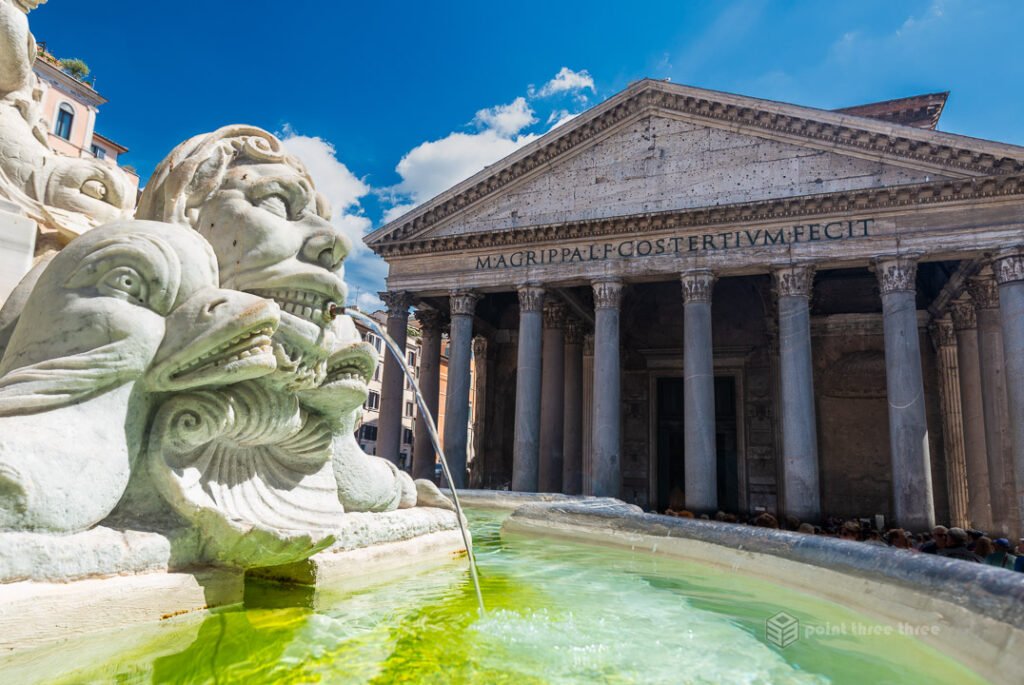
The Pantheon is one of the best-preserved buildings from ancient Rome and a masterpiece of Roman engineering. Originally commissioned by Marcus Agrippa around 27 BC and later rebuilt by Hadrian in the 2nd century AD, it was designed as a temple to all Roman gods.
Built around 126 AD during Emperor Hadrian’s reign. Features world’s largest unreinforced concrete dome (still engineering marvel 2,000 years later).
Here is the official website to plan your visit : www.pantheonroma.com
As with other popular attractions in Rome it can get very busy. When we reserved tickets online we had a specific timeslot for our admission. That worked out well so I would recommend booking in advance.
Photography can be a challenge in the interior. To capture a lot of the dome you will need to use a very wide lens and deal with a very high dynamic range if the oculus is framed.
If you are there midday, you maybe treated to have a dramatic shaft of light in your composition.
Outside, I enjoyed trying compositions with the fountain in the Piazza but if you want to avoid people go early, it’s a busy place!
Castel and Pont Sant’Angelo
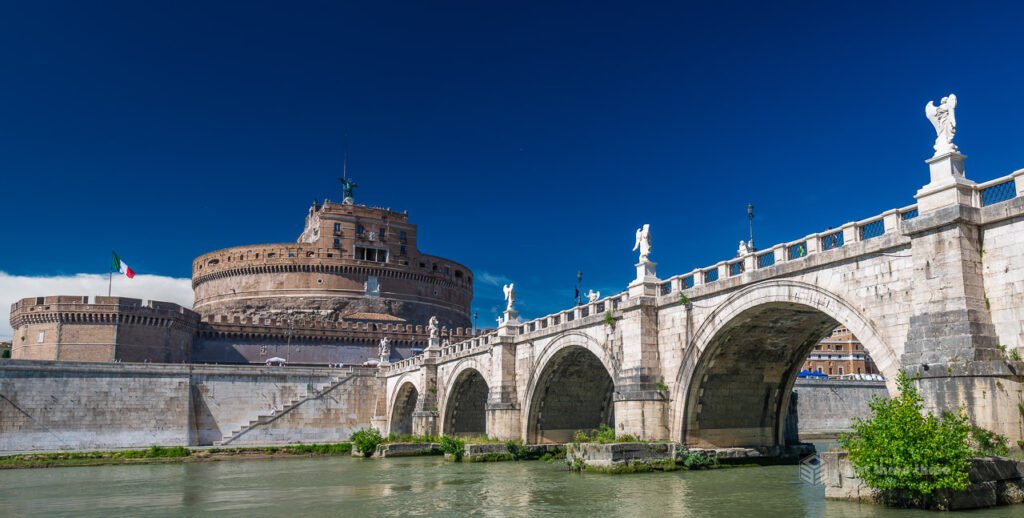
See also my photo: St. Peter’s Basilica and Ponte Sant’Angelo
As part of Day 3 which we walked to several of the attractions around the Pantheon, we strolled across Pont Sant’ Angelo to Castel Sant’ Angelo. I can also recommend taking the steps down to the River Tiber. There are some beautiful compositions of the bridge and castle.
The Castel was originally Emperor Hadrian’s mausoleum (135-139 AD). It was later fortress, castle and papal residence.
Capitoline Museum
We had not originally planned to visit this museum but happy we did. We substituted this for the canceled Pompeii excursion. This is apparently Rome’s oldest public museums with impressive ancient Roman art. Our daughter recommended this with the knowledge of the collection and glad we did.
The collection focuses on ancient Roman art and sculpture, including iconic works like the bronze Capitoline Wolf, the equestrian statue of Marcus Aurelius, and extensive displays of inscriptions, mosaics, and imperial portraits.
Here is the official link to plan your visit : https://www.museicapitolini.org/en/node
Trevi Fountain – Baroque Masterpiece
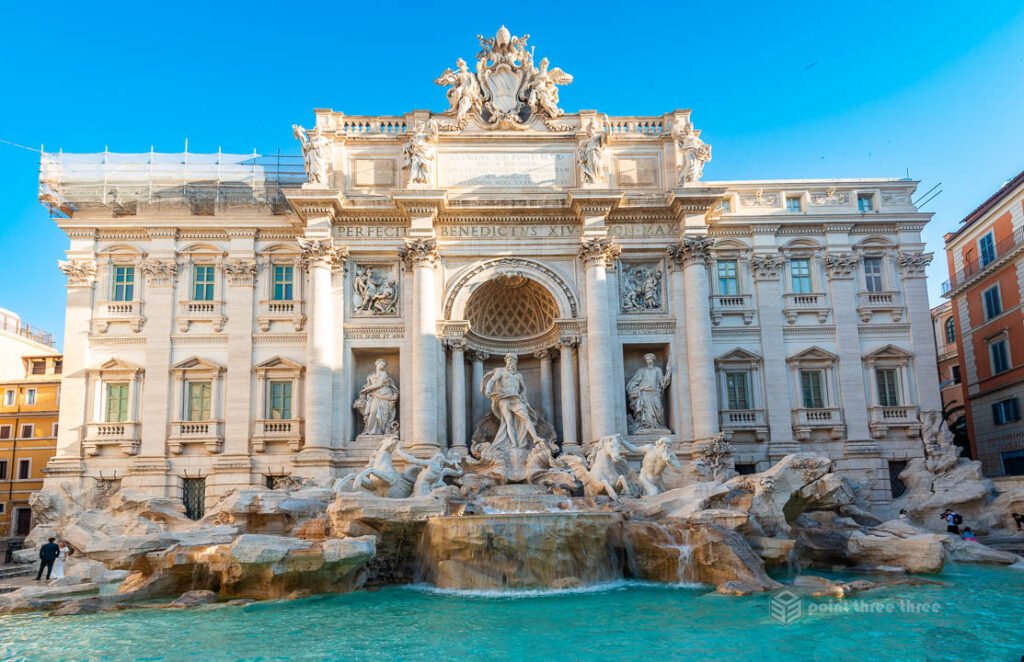
Rome’s most famous fountain (completed 1762), depicting Neptune’s chariot. It is an architectural beauty.
However, it is a bit of circus at the attraction. It is pretty much crowded all the time! You will get to observe young ladies in evening gowns perfecting the art of selfies. We even had a bride and groom there at 7:30am in the morning. Suffice to say, if you want to have your own time by the fountain, get there at sunrise. Even at 7am it was filling up with people.
And of course, as part of the tradition, throw a coin over left shoulder with right hand – legend says you’ll return to Rome!
Conclusion: Your Italy Photography Adventure Awaits
Our Italy itinerary delivered everything we hoped for and more. From watching sunrise over the Duomo’s intricate marble spires to capturing the iconic Manarola sunset over the Cinque Terre, from the cypress-lined hills of Tuscany to our final blue hour photographing St. Peter’s from Ponte Umberto, this journey exceeded our expectations.
This Italy photography itinerary is ambitious and demands early mornings, flexibility, physical stamina, and passion for capturing beautiful images. But if you’re family unit is up to the pace and you are dedicated to photography and want to experience Italy’s incredible diversity in under two weeks, this route delivers exceptional results.
Its not a matter of if we come back to Italy and explore more, but when!
Would we change things? Yes – we’d add more time in Bologna, and build in time to visit Pompeii. But these are refinements to what was already an unforgettable journey.
Of course if you had not visited Florence and Pisa, you may want to consider that as well, as they are both wonderful locations. We would also layer other Tuscan locations like Siena.
This comprehensive guide provides everything you need to recreate our 12-day Italy photography adventure from Milan to Rome. Use it, adapt it to your interests, add your own discoveries, and create your own unforgettable Italian memories.
**Buon viaggio e buona fotografia!** (Safe travels and good photography!)