CPP Calculator (2026): Canada Pension Plan Retirement Estimator

CPP calculator for 2026 — Canadian bills and coins with a rising chart
Use this free CPP calculator to estimate your Canada Pension Plan retirement pension, including the CPP enhancement, and compare starting at any age from 60 to 70.

Share : 

September 2026 — this CPP calculator uses the 2026 CPP earnings ceilings and includes the CPP enhancement.

Table of Contents

Introduction

When you start the Canada Pension Plan (CPP) is one of the few retirement decisions you only get to make once. Start at 60 and your pension is permanently cut by 36%. Wait until 70 and it’s permanently 42% higher. Either way, the payments are indexed to inflation and last for life.

I built this CPP calculator from the spreadsheet I use for my own retirement planning. It estimates your CPP retirement pension from your earnings history, includes the CPP enhancement that started in 2019, and compares every start age from 60 to 70 side by side.

How to use this page: The CPP calculator is further down. Enter the year you were born and choose how to estimate your earnings:

  • Quick estimate: your salary today and the ages you worked. Good for a first look.
  • My earnings history: year-by-year earnings from your Statement of Contributions. The most accurate option.
  • I know my %: if you already have a Service Canada estimate.

Results update as you type. Nothing you enter is sent anywhere; it’s all calculated in your browser.

Disclaimer: I’m not a financial planner or a pension expert. I’ve implemented the CPP rules as published by the Government of Canada to the best of my knowledge and tested the results carefully (see How Accurate Is This CPP Calculator? below). For your official estimate, check My Service Canada Account.

The CPP Calculator

2026 CPP Rates
Canada Pension Plan
Retirement Calculator

Estimate your CPP retirement pension, including the CPP enhancement, and compare starting anywhere from age 60 to 70.

About You
Planners often use 90–95. Outliving your savings is the bigger risk.
65
Starting early reduces your pension 0.6% per month before 65 (up to 36%); waiting increases it 0.7% per month after 65 (up to 42%).
Your Earnings
$
Employment or self-employment earnings before tax.
Your retirement age. It can differ from when you start CPP. Many people stop working first and delay CPP.

Assumes you earned at the same level relative to the CPP earnings ceiling throughout your career. Career breaks or big income changes? Use My earnings history for a more accurate result.

Assumptions
Show amounts in
Today's dollars show buying power. Future dollars are the amounts you'd actually see, including inflation.
%
Grows future CPP earnings ceilings. CPP payments rise with inflation once they start.
%
Used only for the "lifetime value" comparison. Higher returns favour starting CPP earlier.
Estimates only. This calculator works in whole years and doesn't include the disability drop-out, the Post-Retirement Benefit, or survivor benefits. Your official estimate is in My Service Canada Account.

🔒 Everything is calculated in your browser. Nothing you enter is sent anywhere.

Your Estimated CPP

Monthly at 65
— / month
Per Year
—
Of the Maximum
—
Lifetime Total
—
Best start age by lifetime value: —
Break-even vs. 65: —

What makes up your pension

Monthly amounts at your chosen start age

Monthly payment by start age

Lifetime value by start age

Compare start ages

Start ageMonthlyPer yearTotal to age Lifetime value*Breaks even with 65 at

* Present value at age 65 using your expected investment return. ★ = highest lifetime value. The totals add up payments in today's dollars.

Your earnings record

Each year as a % of that year's CPP earnings ceiling. Dropped years are your lowest ones, removed by the 17% general drop-out.

How this was calculated

How CPP Is Calculated

Your CPP retirement pension depends on how much you earned, for how many years, and when you start it. Here’s how the pieces fit together.

1. Your contributory period

CPP looks at every year from age 18 until you start your pension (or age 70, whichever comes first). Each year, only earnings up to that year’s ceiling count.

2. Two earnings ceilings

  • Year’s Maximum Pensionable Earnings (YMPE): the first ceiling, $74,600 in 2026. It rises each year with average wages.
  • Year’s Additional Maximum Pensionable Earnings (YAMPE): a second, higher ceiling added in 2024, $85,000 in 2026. Earnings between the two ceilings build extra pension.

Earnings of $3,500 or less in a year (the Year’s Basic Exemption) mean no contributions for that year, so it counts as zero.

3. Base CPP: 25% of your average earnings

Each year’s earnings are expressed as a percentage of that year’s YMPE, so a 1995 salary and a 2025 salary compare fairly. Those percentages are averaged and multiplied by the average YMPE for the year you start CPP and the four years before it. Base CPP replaces 25% of that amount.

4. Drop-outs remove your weakest years

  • General drop-out: CPP automatically drops your lowest-earning 17% of years (about 8 years for most people).
  • Child-rearing drop-out: years when you were the main caregiver of a child under 7 and earned less can be removed entirely.
  • After 65: if you delay CPP past 65, strong earning years after 65 can replace weaker earlier years.

5. The CPP enhancement (since 2019)

Starting in 2019, contributions increased and so does the pension they buy. The enhancement adds two parts on top of base CPP:

  • First additional CPP: 8.33% of earnings up to the YMPE, phased in from 2019 to 2023.
  • Second additional CPP: 33.33% of earnings between the YMPE and the YAMPE, from 2024.

Both are averaged over your best 40 years, with no drop-outs. That means the enhancement builds slowly: someone retiring today gets only a small top-up, while someone starting their career now will eventually get CPP replacing about one third of their earnings instead of one quarter.

6. The start-age adjustment

Your pension is then permanently adjusted for the age you start it:

  • Before 65: reduced 0.6% for each month early. At 60 you get 64% of your age-65 amount.
  • After 65: increased 0.7% for each month you wait. At 70 you get 142% of your age-65 amount.
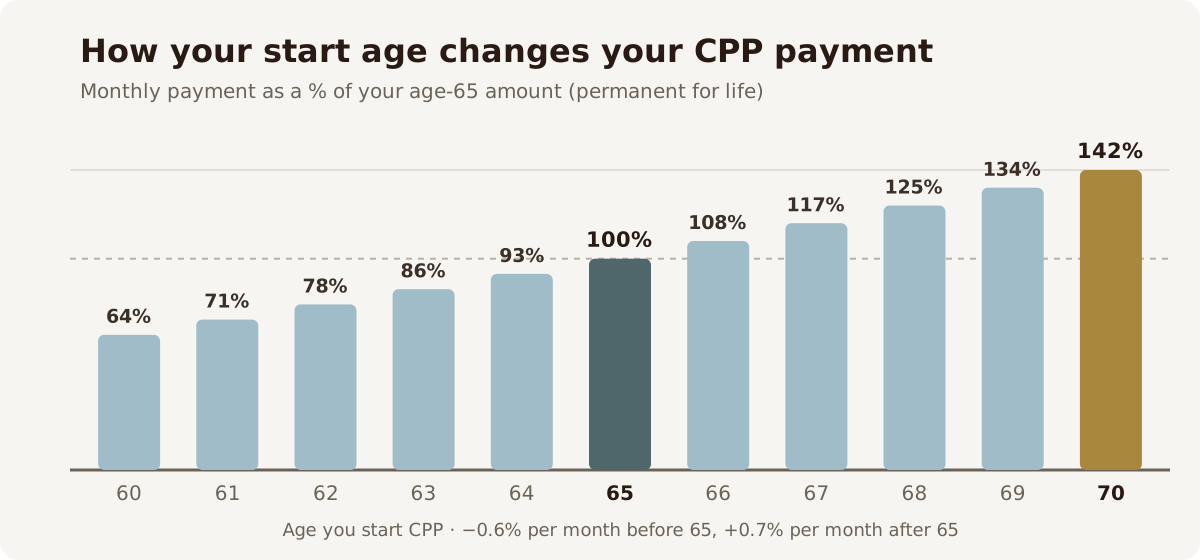
CPP calculator chart: CPP payment as a percentage of the age-65 amount for start ages 60 to 70
Starting CPP at 60 pays 64% of your age-65 amount for life; waiting until 70 pays 142%.

2026 CPP at a Glance

2026 CPP figureAmount
Year’s Maximum Pensionable Earnings (YMPE)$74,600
Year’s Additional Maximum Pensionable Earnings (YAMPE)$85,000
Year’s Basic Exemption$3,500
Employee contribution rate (up to the YMPE)5.95%
Maximum employee contribution (up to the YMPE)$4,230.45
CPP2 rate (between YMPE and YAMPE)4%
Maximum employee CPP2 contribution$416.00
Maximum monthly pension starting at 65$1,507.65

Self-employed Canadians pay both the employee and employer portions, so double the contribution amounts.

When Should You Start CPP?

The CPP calculator gives you two ways to compare start ages.

Break-even age is the age when waiting pays off. If you start at 70 instead of 65, you give up five years of payments but receive 42% more for life. The break-even age is when the bigger cheques have made up for the ones you skipped, typically around age 81–82 in today’s dollars. Live past it and waiting paid off.

Lifetime value goes a step further. It converts all your future payments into a single amount at age 65 using an expected investment return. The idea is that money received earlier could be invested. A higher expected return favours starting earlier; a lower one favours waiting. The start age with the highest lifetime value is marked with a star in the comparison table.

The numbers are only part of the decision. Things worth weighing:

  • Health and family history. CPP is insurance against living a long time. The longer you expect to live, the better waiting looks.
  • Other income. If you’ve stopped working at 60, drawing on RRSPs first and delaying CPP can smooth your taxable income and reduce OAS clawback risk later.
  • Inflation protection. CPP rises with inflation every January for life, which is hard and expensive to buy any other way.
  • Survivors. A larger CPP can also mean a larger survivor pension for your spouse or partner.

Many planners suggest that if you’re healthy and can afford to wait, delaying CPP is one of the cheapest ways to buy guaranteed, inflation-protected income. But there’s no single right answer.

How Accurate Is This CPP Calculator?

Because this CPP calculator is a planning tool, I wanted to know how close it gets. Here’s how I tested it:

  • Official maximums: for someone who contributed the maximum every year, it reproduces the government’s published maximum pension at 65 for 2022 through 2026, within a cent.
  • Independent check: the calculator matches a separate implementation of the same rules across many earnings histories, start ages and settings.
  • Spreadsheet match: the web version matches my spreadsheet to the cent across 18 test scenarios.
  • Common-sense tests: more income never lowers the pension, earnings above the ceiling add nothing, and each start age gets exactly the right adjustment.

This CPP calculator started life as a version of the popular CPP spreadsheet from The Measure of a Plan. I’ve since reworked how it handles the CPP enhancement and the second earnings ceiling, which brings its maximums in line with the official figures.

What it simplifies:

  • It works in whole calendar years rather than months, so results can differ from the official month-by-month calculation by a small amount, usually well under 1%, and up to about 2% if you start CPP after 65 with low early years.
  • It ticks child-rearing years off completely. The real rule only removes them if it helps, so only tick years where your earnings were low.
  • It doesn’t include the disability drop-out, the Post-Retirement Benefit for working while receiving CPP, credit splitting after a separation, or survivor benefits.
  • Future earnings ceilings grow at your inflation assumption, which may differ from actual wage growth.

Frequently Asked Questions

What is the maximum CPP payment in 2026?

The maximum monthly CPP retirement pension for someone starting at 65 in 2026 is $1,507.65, or about $18,092 a year. Very few people receive the maximum. It requires earning at or above the YMPE for about 39 of the years between 18 and 65.

How much CPP will I get if I start at 60?

Starting at 60 gives you 64% of your age-65 amount, a permanent 36% reduction. Your earnings record also ends at 60 instead of 65, and the pension is based on earlier (lower) earnings ceilings, so the difference can be a little more than 36%. The calculator includes both effects.

Is it better to take CPP at 65 or 70?

Waiting until 70 increases your pension by 42% for life. In today’s dollars, the break-even age versus starting at 65 is usually around 81 or 82. If you’re healthy and can cover your spending from savings in the meantime, waiting often comes out ahead. The comparison table in the CPP calculator shows your own numbers.

How is the CPP enhancement calculated?

The enhancement adds two parts to base CPP. The first additional part is 8.33% of your earnings up to the YMPE from 2019 onward. The second additional part is 33.33% of your earnings between the YMPE and the YAMPE from 2024 onward. Both are averaged over your best 40 years, so they build up gradually over a full career.

What is the child-rearing drop-out?

If you were the main caregiver of a child under 7, the years (or months) when your earnings were lower can be removed from your CPP calculation, which raises your average. You apply for it when you apply for CPP.

Where do I find my past CPP earnings?

Sign in to My Service Canada Account and look for your Statement of Contributions. It lists your pensionable earnings for every year. You can copy the earnings column and paste it straight into the calculator’s earnings grid.

Does CPP go up with inflation?

Yes. Once you start receiving CPP, your payment is adjusted every January to match the change in the Consumer Price Index. Choose Future dollars in the calculator’s assumptions to see payments including inflation.

Is CPP taxable?

Yes. CPP is taxable income. You can ask Service Canada to withhold tax from your payments. My Canadian Income Tax Calculator can help estimate the tax on your retirement income.

Online Resources

This CPP calculator gives an estimate. For your official numbers and the full rules, these are the best places to go:

Planning the rest of your retirement income? My Canadian Income Tax Calculator shows what you’ll keep after tax.

Subscribe
Notify of
guest
0 Comments
Oldest
Newest Most Voted

About point three three

pointthreethree

Fine Art Photography with blogs covering Photography, Travel, DIY and Personal Finance.

Other Posts

0
Would love your thoughts, please comment.x
()
x